

AI providers offer model menus that differ by capability, speed, context, tools and price. For a business, the useful question is which available option can complete a defined task to the required standard at the lowest total cost.
Total cost includes the model, staff review, corrections, delay and failures. A low token price can lose its advantage when somebody must repair the output. A premium model can waste money and capacity when the task needs simple, checkable processing.
You need a task definition, a quality threshold and evidence from your own work.
Separate the Platform, Model and Tool
Teams often use tool, platform and model as if they mean the same thing.
They affect different parts of the decision:
- Platform: the application or service your team uses, including access controls, data handling, integrations and subscription limits.
- Model: the system that processes the request, with a particular mix of capability, speed, context and price.
- Tool: an added capability such as web search, code execution, file retrieval or image analysis.
A strong text model without current search cannot verify today's information. A model with a large context window may still fail if you fill that window with stale or conflicting material. A cheap model inside an unsuitable platform may create a data-handling problem.
Choose the operating environment first. Choose the model route for the task inside that environment.
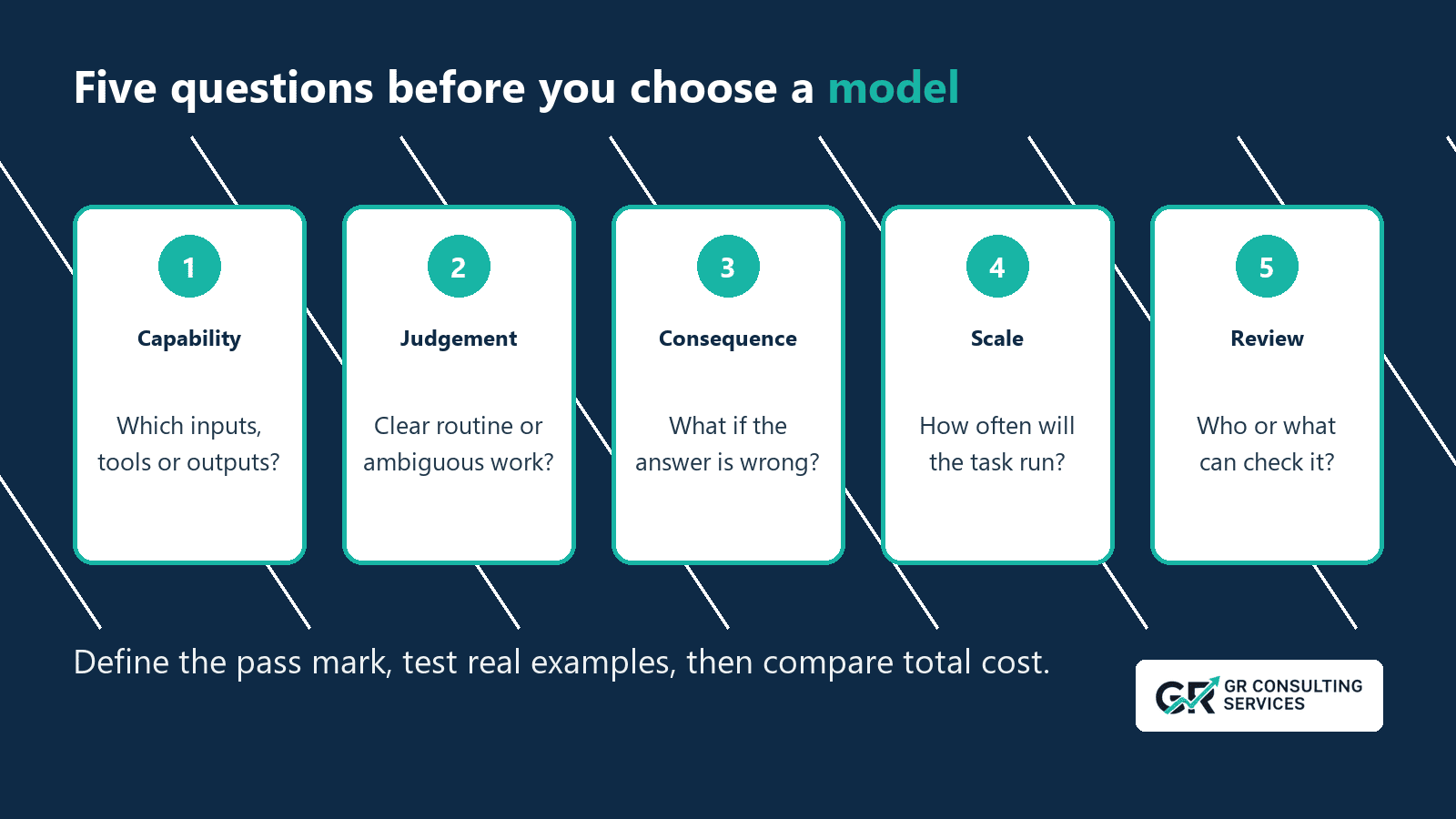
2. How much judgement does the task need?
Routine processing follows stated information and a stable structure. Examples include extraction, formatting and classification against known categories.
Judgement-heavy work asks the model to resolve ambiguity, compare evidence, plan across constraints or explain an unfamiliar problem. Those tasks tend to benefit from stronger reasoning and more time.
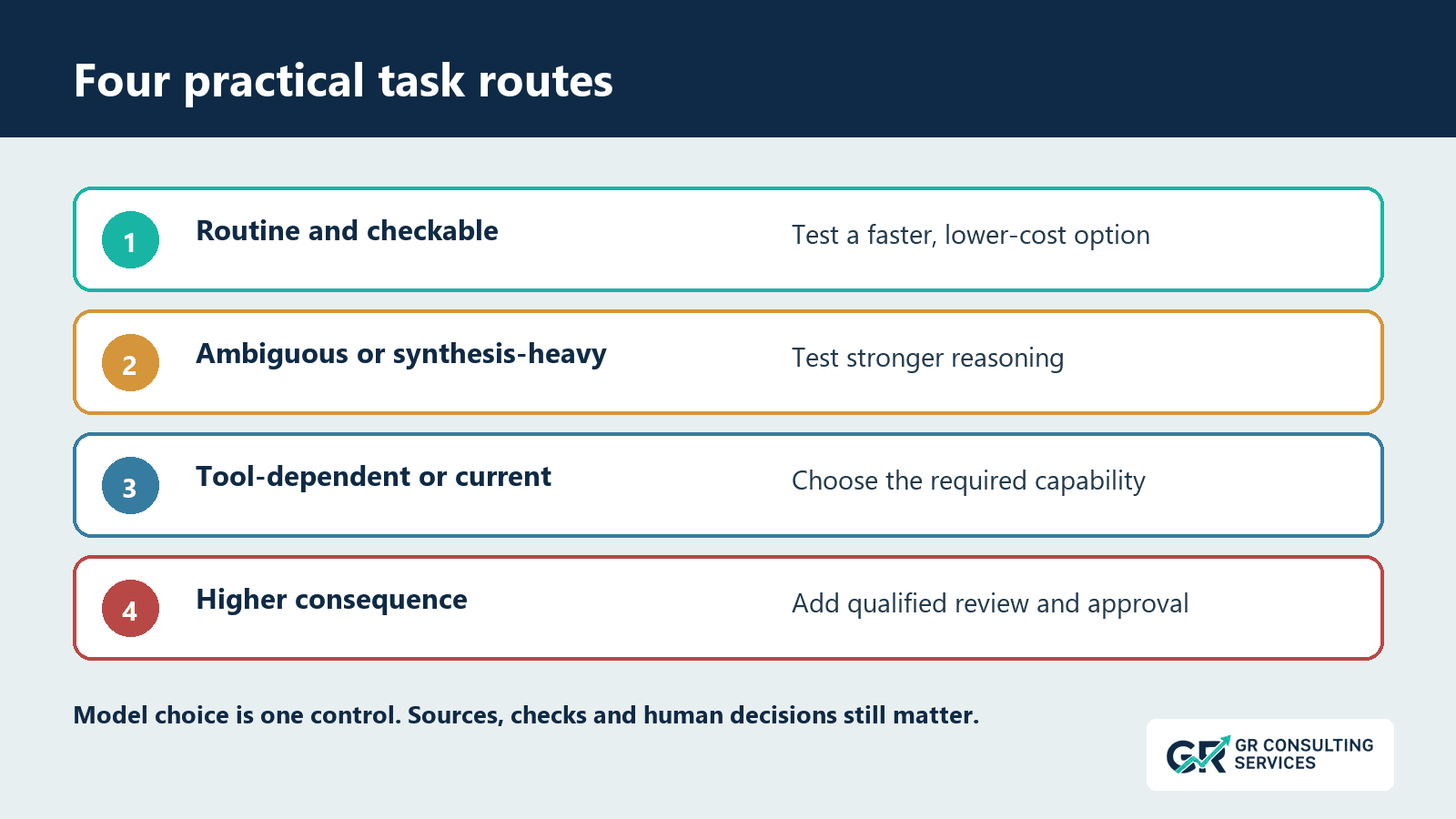
Some jobs contain both. Route the routine part through a lower-cost model, then escalate conflicts or low-confidence cases to a stronger model or a person.
3. What happens if the answer is wrong?
Match the workflow to the consequence of an error.
A rough internal headline draft is reversible. A client commitment, tax treatment, employment decision, medical conclusion or regulated recommendation carries a different exposure.
For higher-consequence work, add approved sources, qualified review, evidence checks and sign-off. Some uses remain unsuitable for unsupervised AI support.
4. How often will the task run?
At high volume, small differences create material cost.
For API work, estimate:
Monthly model cost =runs * ((input tokens * input rate) + (output tokens * output rate))/ 1,000,000+ tool and storage charges
Then add staff time:
Monthly review cost =runs * average review minutes / 60 * staff cost per hour
Use current rates from the relevant provider. OpenAI and Google list separate input, output, caching and tool charges across their model families. Some platforms also offer effort controls, batch processing or service tiers that can change the cost and speed trade-off without requiring a different model. Subscription users should track usage limits, waiting time and staff capacity instead of assigning each chat an invented unit price.
5. Can you check the result?
If a reviewer can check routine output without repeating the work, you may be able to use a cheaper option.
Useful checks include:
- exact-field comparison against a source;
- schema or format validation;
- calculation tests;
- citations that a person opens and checks;
- approval by a named person who knows the subject.
A subjective output needs a rubric and a named, capable reviewer. Record correction time as part of the model's total cost. A task with no credible review route needs redesign before automation.
| Measure | Question |
|---|---|
| Task accuracy | Did it produce the right result? |
| Requirement coverage | Did it follow each stated rule? |
| Unsupported content | Did it invent facts, owners, dates or sources? |
| Edge-case handling | Did it flag ambiguity and exceptions? |
| Review effort | How many minutes did a person need? |
| Response time | Did latency fit the workflow? |
| Direct cost | What did tokens, tools or plan limits cost? |
Anthropic's current model-selection guidance recommends this use-case testing approach: benchmark with your prompts and data, compare accuracy and edge cases, then weigh performance against cost.
Keep the test set. Re-run it when a provider changes a model, you change the prompt or the task changes.
GR Consulting Services helps founder-led SMEs define practical AI use cases,
compare workable options and build reviewable methods around the tools.
Choose an AI option that fits the work and the budget.
Run the five-question check on one repeated, low-risk job. If product choices, costs or review requirements are blocking progress, book an opportunity call with GR Consulting Services. We will compare the task with the available options and define a sensible test.