

The workshop ends with agreement: the team will improve enquiry follow-up. Back at work, an enquiry arrives without enough information for a quotation. Someone forwards it to a colleague. Nobody confirms who will ask the customer for the missing details.
The plan has reached the point where it needs an operating decision.
This is an illustrative small-wholesaler scenario, not a client case. It shows the gap between agreeing an improvement and making it work during an ordinary day. Closing that gap means defining the next action, securing an owner's agreement and making room for the work.
Turn the intention into one observable change
“Improve enquiry follow-up” describes a direction. It does not tell the team what to do differently when the next enquiry arrives.
Choose one part of the process to improve first. For the wholesaler, that could be the hand-off between receiving an enquiry and preparing a quotation.
Define a practical test: for each enquiry in the agreed trial, the team should be able to identify its current status, its owner and the next action. An enquiry missing information should remain visible rather than disappearing into a forwarded email.
Use a shared record in a tool the team can already access. Check whether the existing system can support the change before commissioning another one.
Agree who accepts the next step
Being copied into an email does not establish that someone has accepted responsibility.
In the example, the enquiry coordinator owns the request until the quotation preparer accepts the hand-off. That acceptance includes checking that the necessary information is available. If it is not, the coordinator remains responsible for obtaining it or agreeing a different route.
Separate two responsibilities:
- The action owner progresses the individual enquiry.
- The improvement owner makes sure the new hand-off process is introduced, understood and reviewed.
One person may perform both roles in a small business. Naming the distinction helps avoid treating every missed enquiry as an isolated mistake when the process itself is unclear.
The improvement owner also needs a route to someone who can resolve competing priorities. Responsibility without authority to obtain decisions leaves another obstacle in the plan.
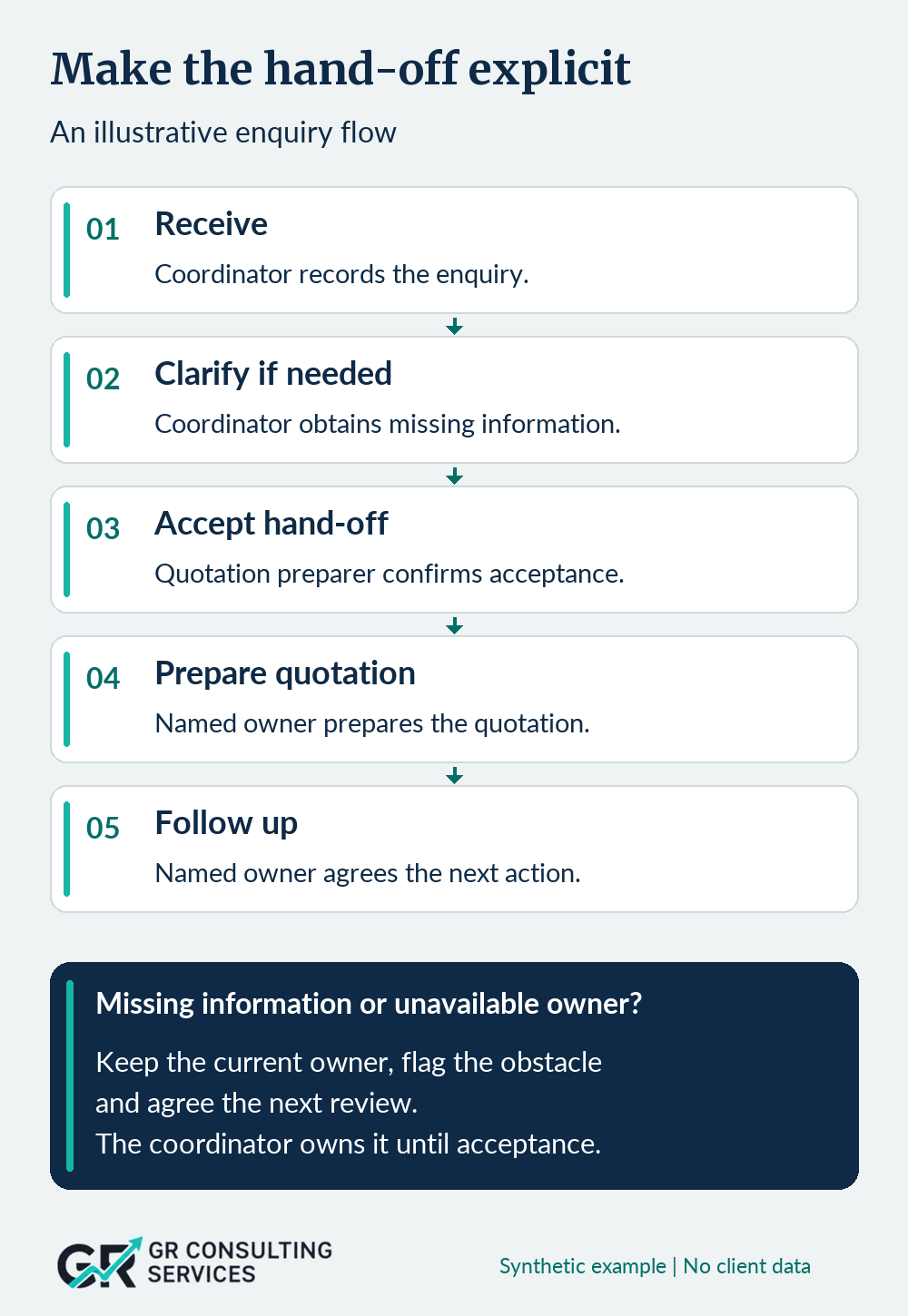
An enquiry needs an accepted owner and a visible next action, including when the normal route is blocked.
Make the next action specific enough to complete
Replace “follow up” with an action someone can perform and another person can verify.
For example: “Ask the customer to confirm the required quantity and delivery location, then update the enquiry record.”
Agree when that action is due and what counts as completion. Sending the question completes that action; it does not mean the enquiry is ready for quotation. While the team waits for a response, the record should show that status and the next review point.
An internal due date is also different from a promise made to a customer. Do not invent a delivery date or quotation commitment because the plan needs a date in every box.
Check capacity before agreeing the date
The person taking the action may already have a full workload. Ask what time the work requires, what information it depends on and what would need to move to make room.
If the quotation preparer cannot take the work, decide whether to reassign it, change the internal deadline or narrow the trial. Where a customer commitment may be affected, an authorised person must agree the response.
Record the trade-off. Adding a name and a deadline to an action does not create the capacity to deliver it.
Give exceptions somewhere to go
Test the process with an awkward case as well as a straightforward one.
For the wholesaler, consider an enquiry with missing quantities, an unavailable owner or conflicting delivery information. Specify who handles each exception and how the enquiry stays visible while the issue is resolved.
The fallback may be entirely manual. A coordinator can flag the record, contact the relevant colleague and escalate an unresolved decision. The important point is that the process stops unsupported commitments rather than encouraging someone to guess.
AI is optional here. It could help draft a clarification from approved information, but a person still checks the facts and authorises any external message. It cannot settle an unresolved commercial decision simply by producing fluent wording.
Keep a short review record
Use enough detail to see whether work is progressing and what is preventing it.
| Field | Illustrative enquiry record |
|---|---|
| Status | Awaiting customer clarification |
| Action owner | Enquiry coordinator |
| Next action | Request quantity and delivery location |
| Internal due point | Next working day, agreed with the action owner |
| Subsequent review | Separate agreed check if the customer has not responded |
| Obstacle | Information needed before quotation preparation |
| Completion evidence | Sent clarification and updated enquiry record |
| Next hand-off | Quotation preparer accepts once required details are available |
These are dummy roles and conditions, not a prescribed response-time standard. Set dates and review intervals that reflect the work, capacity and commitments of your business.
At the agreed review, examine a few actual records with appropriate access. Can the team identify the next owner? Are enquiries waiting for decisions nobody can make? Is the new record helping, or duplicating information people already maintain elsewhere?
Count avoidable hand-backs or missing-information cases if those measures help assess the change. Establish a starting point before claiming improvement. A completed action list alone does not prove better customer service or more sales.
Decide what becomes everyday practice
Before closing the improvement, agree who maintains the process, briefs a new colleague and responds when the arrangement stops working.
The Association for Project Management's handover guidance emphasises involving the people who will use the result and preparing the move into everyday operation. Its project guidance supports that principle; the enquiry method here is a proportionate small-business illustration, not an APM-prescribed checklist.
At the review point, decide whether to keep the arrangement, adjust one weakness or stop the trial. Expand it only when the team can explain how the current hand-off works and who keeps it working.
Take one improvement from your last workshop. Identify the first observable change, the person who has accepted it and the next review point. If any of those is missing, that is the next piece of work.
If several priorities or hand-offs need untangling before you can choose a practical starting point, apply for a Business Clarity Diagnostic.
Source and scope
Association for Project Management: factors for successful project handover, checked 30 October 2026. The guidance concerns project handover; this article adapts the principle to a small operational improvement. The scenario and record are synthetic. No client outcome, time saving or sales result is claimed.
Visual credits: Illustration: GR Consulting Services; AI-generated background with branded editorial layout. Diagram: GR Consulting Services. Synthetic example, no client data.