

The Hidden Maintenance Work Behind a Small Business AI Workspace

11 Sep 2026 09:26 AM Comment(s) By GR Consulting Services

If your team uses AI to turn meeting notes into actions, answer customer questions or prepare reports, someone still needs to keep its information current. A changed deadline, an old instruction or an unclear reviewer can leave you checking work you expected the system to simplify.

While developing our own AI workspace at GR Consulting Services, we found that expanding it created more maintenance work. Related records and instructions needed attention as the system grew. That is our internal experience, rather than a measurement of how often this happens in other small businesses.

For a founder considering another AI workflow, the practical question is: who will keep this useful after the initial build?
Start with the record your team relies on

Consider a small team using AI to draft its weekly meeting actions. The draft goes into a shared document, a task list and an email. A delivery date then changes. Updating the email alone may leave the task list and the next AI request using the old date.

This is an illustrative example. It shows why a useful output needs a clear place where the current decision is recorded, plus a way to correct anything that depends on it.

The same question applies to a customer-response assistant using delivery terms or a report built from a sales spreadsheet. Before improving the AI instructions, establish which information the business wants people to rely on.

A five-part maintenance check

Choose one live workflow and write down these five things. Keep the record short enough for its owner to use.

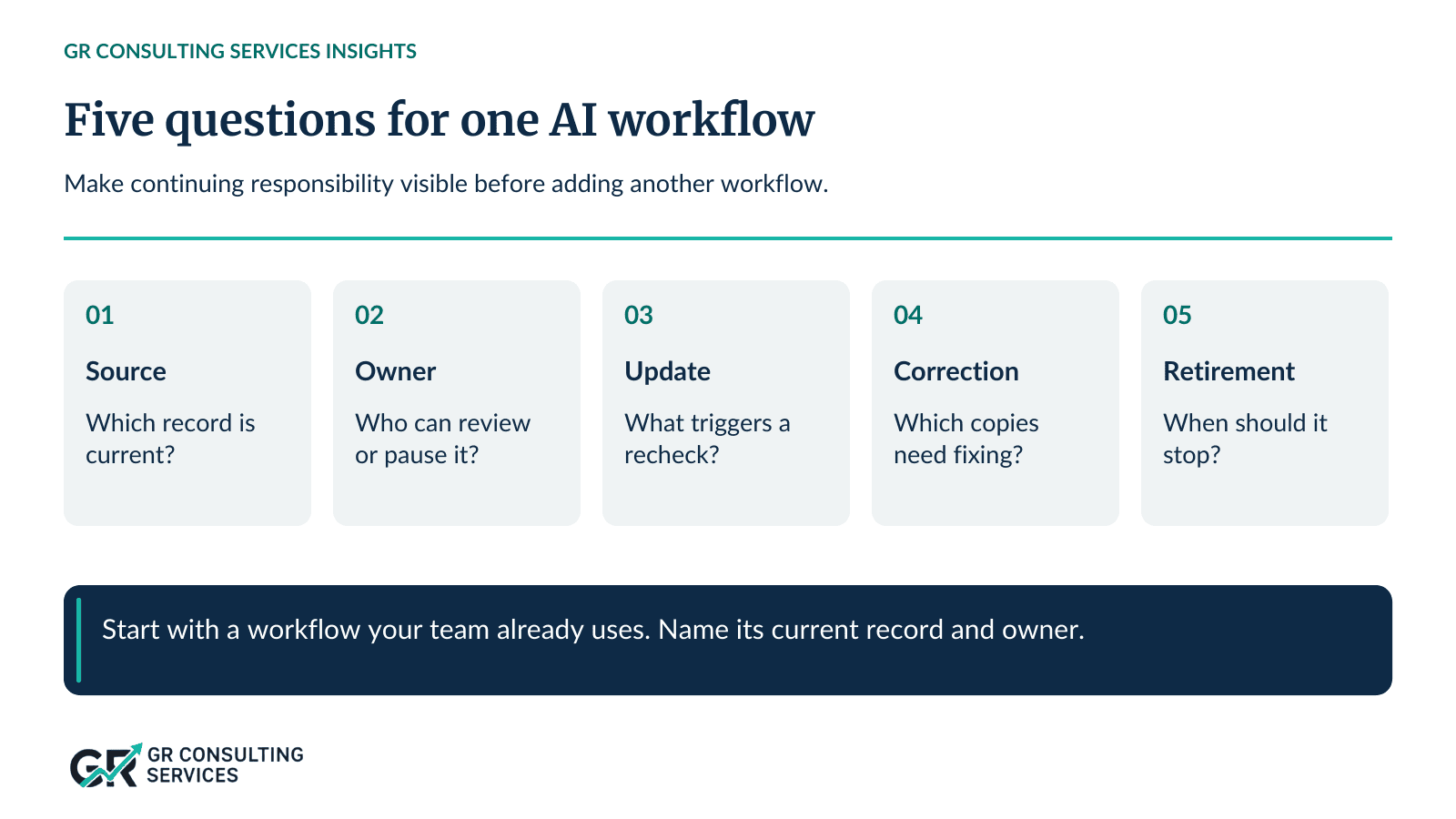
1. Source: which version is current?

Identify the approved business record and the information feeding it. Separate a transcript, a person's interpretation and an approved decision. Each serves a different purpose.

For meeting actions, the current record might be the reviewed action list. The transcript can help resolve uncertainty, but an unreviewed summary should not quietly replace an agreed commitment.

2. Owner: who can make the correction?

Name someone who can check the output, resolve an unclear point and authorise a change. They also need the time and authority to pause the workflow if it becomes unreliable.

In a small business, several responsibilities may sit with one person. Make that allocation explicit so the work does not default to the founder every time something is unclear.

3. Update: what should trigger a recheck?

Record the events that could make the output wrong: a revised deadline, changed delivery terms, a new source file or a different person taking responsibility.

Set a review rhythm that suits the task as well. A scheduled review is useful, but it should not leave a known error in place until the next review date.

4. Correction: where else did the error go?

Correct the current record, then check the copies and instructions that used it. Where people have already acted on incorrect information, tell the affected people what changed.

In the meeting example, that means checking the task list and follow-up message as well as the draft. Record the reason for the correction so a later review can distinguish a changed decision from an inaccurate summary.

5. Retirement: when should this stop?

Decide what would make the workflow no longer worth maintaining. The task may disappear, a simpler process may replace it, or correction work may outweigh the benefit.

Remove retired instructions from active use and mark superseded material clearly. Handle retained records according to the business's applicable retention requirements; stopping a workflow does not automatically mean deleting its history.
Five maintenance questions: which source is current, who owns review, what triggers an update, which copies need correction, and when the workflow should stop.
Apply the five questions to one workflow your team already uses

Worked example: from meeting capture to approved record

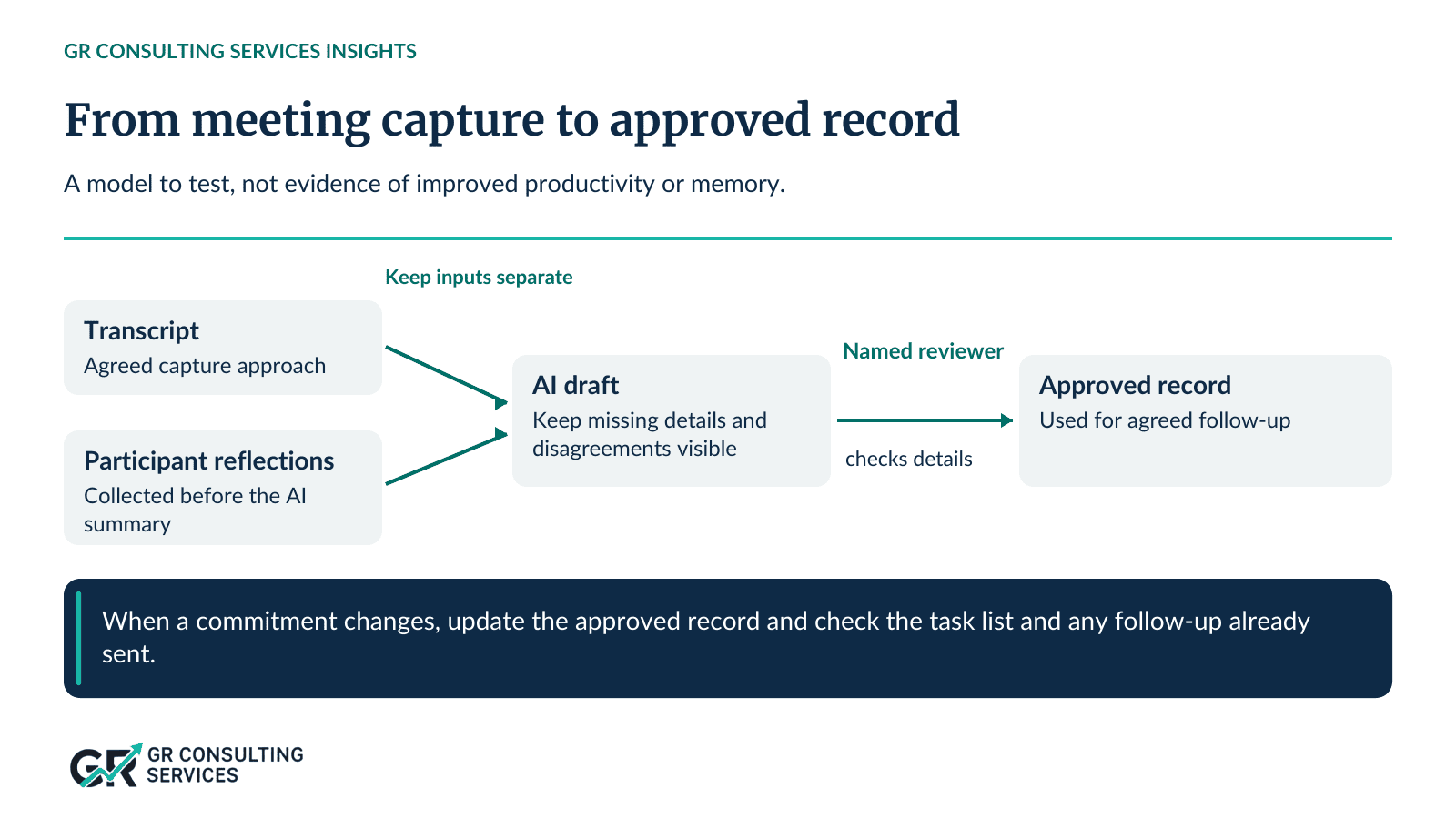
The following is a model to test with one suitable meeting. We have not established that this sequence improves productivity or memory.
  1. Capture the meeting using an appropriate, agreed recording approach and consent where required.
  2. Collect independent reflections before sharing an AI summary. Ask participants for their main takeaway, open questions and understood commitments.
  3. Keep the inputs separate. Give the AI the transcript and attributed reflections without merging differences into an assumed consensus.
  4. Produce a clearly marked draft. Separate decisions, actions, owners, dates, open questions and disagreements. Leave missing details visible.
  5. Name the reviewer. They check consequential details against the source, resolve uncertainty with participants and approve the meeting record before it drives follow-up.

Apply the maintenance check to that sequence. Who updates a changed commitment? Which action list controls? Who corrects a follow-up that has already been sent? What happens when the usual reviewer is away?

Those questions make the continuing work visible before another automated step is added.
Transcript and independent participant reflections feed an AI draft. A named reviewer checks details before the approved record is used for follow-up.
A model to test: keep the inputs, AI draft and approved record distinct. This sequence is not evidence of improved productivity or memory.

Count the effort before expanding

For a few normal runs and at least one exception, record:
  • time preparing inputs and checking outputs;
  • time correcting errors and updating dependent records;
  • delays while someone clarifies an owner or decision;
  • whether the intended business task was completed acceptably.

Compare this with the previous way of doing the same task over a similar period. Include routine upkeep as well as subscription and setup costs. An estimate is a planning assumption until you have observed the work.

There is no universal monthly maintenance allowance that we can responsibly recommend from our experience. The requirement depends on the task, frequency of change and consequences of an error.

Where the method comes from

The UK's data asset management policy connects named ownership with ongoing data-quality management. It applies to specified government bodies, rather than imposing this five-part check on SMEs.

The voluntary NIST AI Risk Management Framework treats review and risk management as continuing lifecycle work. These sources support the underlying principles. The check above is our practical adaptation, not an official standard or evidence of a guaranteed business result.

Choose one next action

Take a workflow your team already uses. Identify its current record, owner and next review trigger. If those are unclear, resolve them before adding another helper or integration.

If you need help deciding what to maintain, simplify or stop, apply for a Business Clarity Diagnostic. This paid first step starts from GBP 495 and helps clarify the main issue and the next sensible route.


GR Consulting Services

https://www.gr-consulting.co.uk/