

One more AI helper can look like extra capacity. Your team also inherits another role to define, feed, supervise and maintain.
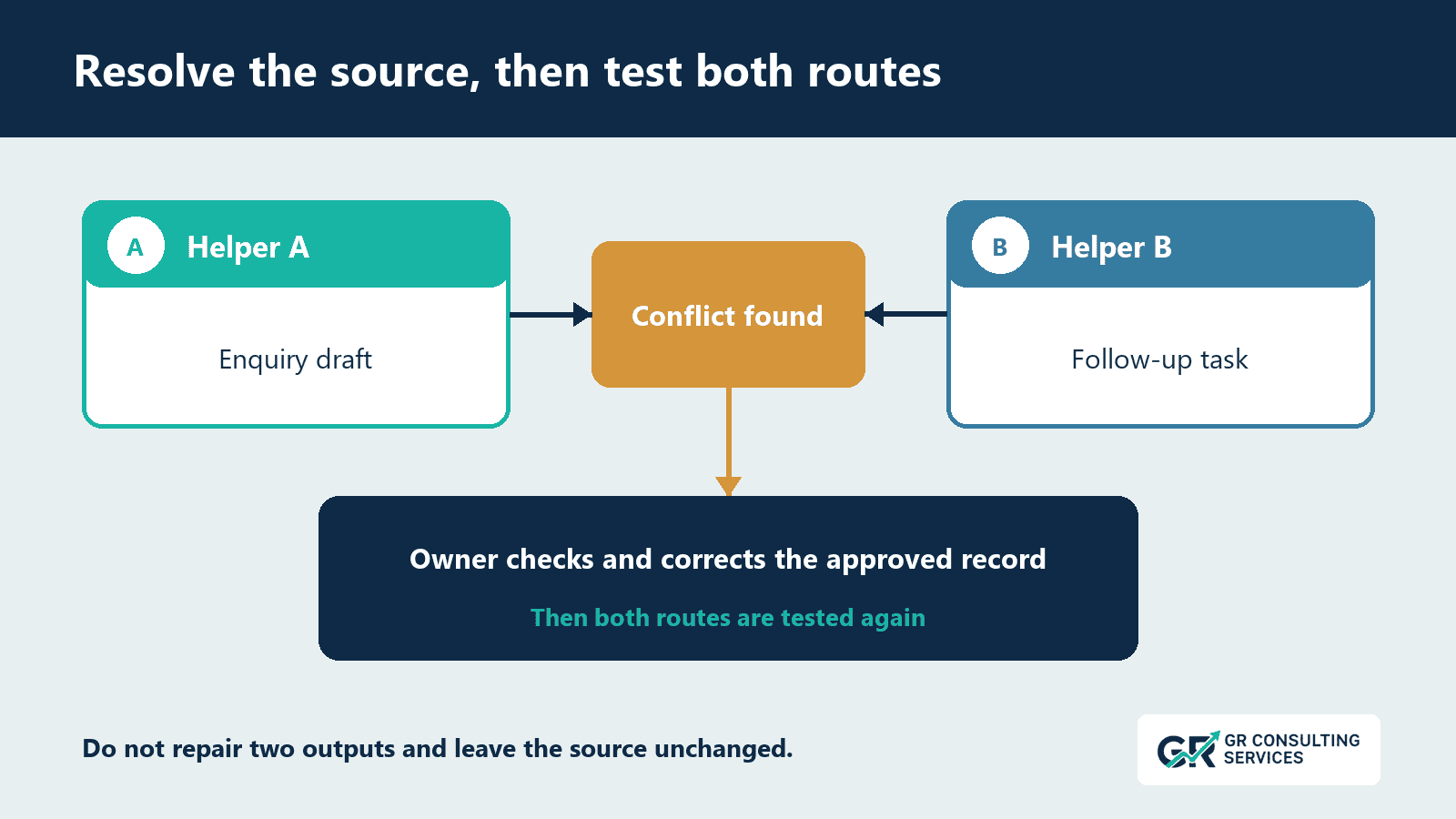
Suppose one helper drafts enquiry replies while another creates follow-up tasks. They use different versions of your service description. Each output sounds plausible, but the reply and task record now contain different promises.
A colleague has to stop the work, decide which record the business trusts, correct the source and test both routes. Fixing the two outputs leaves the conflict in place for the next enquiry.
GR Consulting Services saw a version of this maintenance problem in our own AI workspace: an improvement in one maintained area could leave a related instruction or copy behind. This is an internal observation. We have not measured how often the problem occurs across other small businesses.
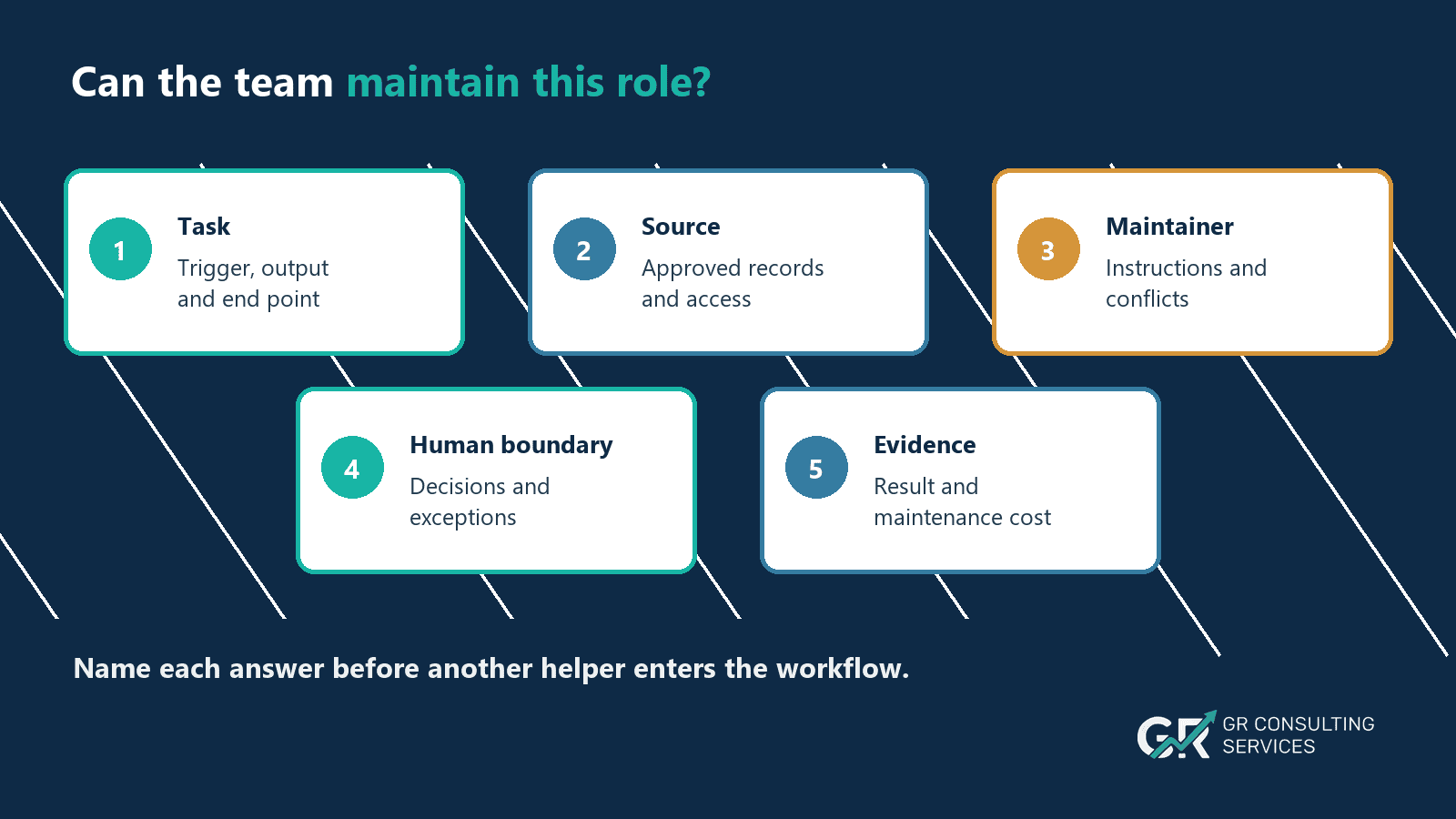
The example changes the build decision. A small team needs to assess the operating footprint before it adds another role.
| Operating element | Decision before launch | Ongoing work |
|---|---|---|
| Task | Define the trigger, output and end point | Check that the task still matches the process |
| Sources | Approve records and access | Update, date and retire old records |
| Instructions | Define rules, tone and boundaries | Correct conflicts and test changes |
| Tools | Approve each read or write action | Review access, failures and provider changes |
| Human hand-off | Name exceptions and decision owners | Handle cases, record reasons and refine rules |
| Evidence | Set a baseline and pass mark | Monitor results, review burden and maintenance time |
One person may own several elements in a small business. The name still matters. The team cannot resolve a source conflict unless a person has authority to decide.
The UK Government AI Playbook recommends that teams plan maintenance, transfer knowledge and train staff so the organisation can manage the system over time. NIST also calls for clear roles, inventories, periodic review, monitoring and decommissioning. Both sources address broader organisational settings; the same questions help a small team expose work that a product demonstration leaves out. UK Government AI Playbook and NIST AI RMF Core
Estimate capacity in hours, not job titles. Ask how much time the owner can give each month to source updates, failed cases, instruction changes and testing. Include cover for holidays and staff changes. A role that depends on one person's memory has no durable maintenance route.
Record the reason for each override. Grouping every intervention under `human review` hides the information needed to improve the route. Use categories such as missing field, source conflict, sensitive case, unsupported claim and integration failure.
Set a pause threshold. Examples include one released message with an invented commitment, any client-boundary breach, a source failure or an exception rate above the team's planned capacity. The owner then stops the affected route, uses the manual fallback and investigates the cause.
NIST's AI Risk Management Framework treats monitoring as lifecycle work. Its 2026 report says teams need post-deployment monitoring to check performance in real settings and identify unforeseen outputs or consequences. The report also says monitoring methods remain immature, so each business should state its method and limits rather than imply a standard score. NIST AI RMF Core and NIST post-deployment monitoring report
| Measure | Example pass mark |
|---|---|
| Task boundary | The helper handles only complete, in-scope enquiries |
| Source use | Each draft uses the current approved service record |
| Human boundary | Prices, complaints and unusual commitments stop with a person |
| Correction route | The owner can fix one maintained source and retest the route |
| Review capacity | The named reviewer can handle the expected case volume |
| Business result | Response delay falls without more corrections or missed tasks |
Replace these examples with evidence from your process. A team that receives five enquiries a week needs a different test from a team that receives five hundred.
Measure both sides of the decision:
- response or handling time;
- correction and exception rate;
- reviewer minutes;
- source and instruction maintenance time;
- missed hand-offs or duplicate records;
- customer, staff or compliance effects relevant to the use case.
NIST treats post-deployment monitoring, user input, override, incident response and change management as part of the operating system. Monitoring should answer a decision: keep, narrow, change, pause or retire the role. NIST AI RMF Core
Assess one proposed AI role before your team inherits another system to maintain.
If your business can name the task but not the source, owner, human boundary or evidence, apply for a Business Clarity Diagnostic with GR Consulting Services. This paid first step identifies the main constraint, clarifies priorities and recommends the most sensible route forward. It starts from £495.