

AI can prepare a useful meeting summary in minutes. The business gains little if a person then copies the same decisions into four places, misses one task and corrects the due date three times.
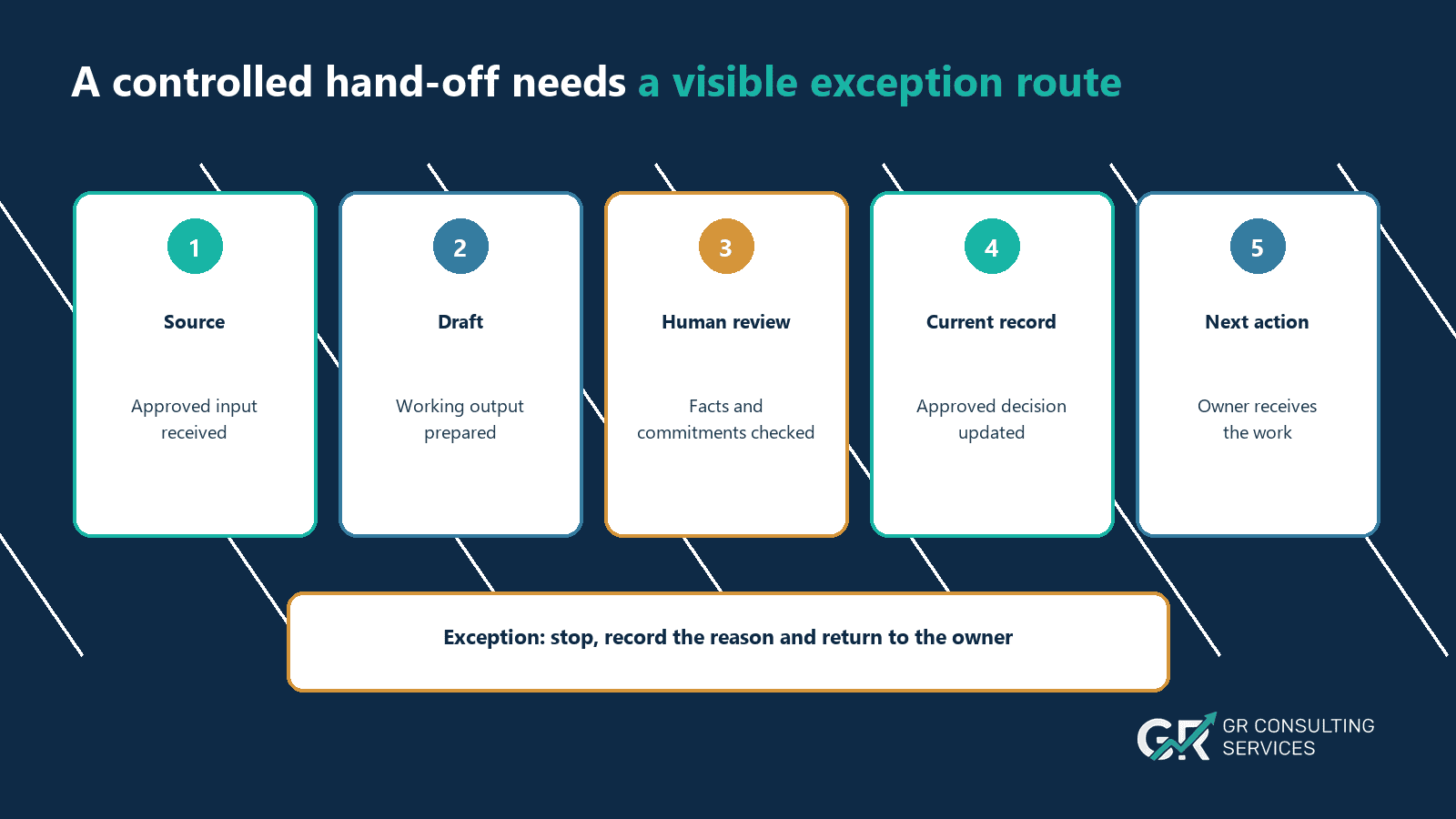
Connect one project before expanding. Map the route from source to reviewed decision, current record and assigned action. Give a person ownership of each approval and exception. Measure the current route before you change it.
The first useful return may come from reducing repeated handling, delay and correction work. A faster draft does not establish that return on its own.
Our Maintenance Lesson
We saw a version of this problem while building and maintaining our own AI workspace. Work in one area could leave a related instruction, summary or task file stale. Each copy looked reasonable until someone compared it with the source.
That experience changed the question we ask before connecting more work. We now look for the current business record, the update owner and the correction route.
This is a GR Consulting Services observation, not evidence of a general SME pattern. The Government Data Quality Framework describes duplication, inconsistency, manual error and declining accuracy as quality risks across the data lifecycle. It advises teams to address problems at source and monitor records that change. Government Data Quality Framework
| Step | Person | Input | Action | Record or output | Failure to watch |
|---|---|---|---|---|---|
| Receive | Meeting owner | Approved transcript or notes | Confirm the source and project | Source record | Wrong meeting, missing section or restricted material |
| Draft | Meeting owner with AI support | Approved source and instructions | Prepare summary, decisions, actions and email | Working draft | Unsupported decision or invented owner |
| Review | Meeting owner | Working draft and source | Check facts, commitments, recipients and sensitivity | Approved meeting record | Reviewer checks wording but misses business meaning |
| Update | Record owner | Approved meeting record | Create or amend task records | Current task records | Due date or owner differs from the approved decision |
| Assign | Task owner | Current task record | Accept, query or schedule the action | Recorded status | Owner never receives or accepts the action |
Follow a real case from start to finish. Record each copy, pause, correction and message. Include the quiet work: finding the right folder, comparing versions, asking who owns an action and checking whether an email went out.
The GOV.UK Service Manual recommends measuring an end-to-end journey through task completion and completion time, then repeating the exercise for comparison. The same principle helps a small team judge the whole workflow instead of the speed of one model response. Measuring the success of your service
| Business question | Current record | Working or supporting material |
|---|---|---|
| What did the meeting decide? | Approved meeting record | Transcript, notes and AI draft |
| Who owns the action and when is it due? | Task record | Meeting record and assignment message |
| What did we tell the participants? | Sent email or approved communication record | Draft email |
| Has the work finished? | Task status | Progress notes and working files |
Mark drafts, approved records and historical records. Keep the source reference with the approved decision. A chat can hold questions and alternatives; it should not compete with the approved business record.
If two systems must contain the same value, define which one has authority and how the other receives an update. Do not ask colleagues to decide from appearance or file date.
The Government Data Quality Framework defines uniqueness as the absence of duplicate records and consistency as the absence of contradictions between records representing the same thing. It also treats timeliness as whether the data remains current enough for its use. Those dimensions provide a useful check for business records, even where the information falls outside the framework's government context.
Personal data needs added care. The ICO says organisations should make its source and status clear, update it when the purpose needs current information and correct inaccurate information without delay. Confirm the lawful purpose, access, retention and provider controls for your workflow. ICO accuracy guidance
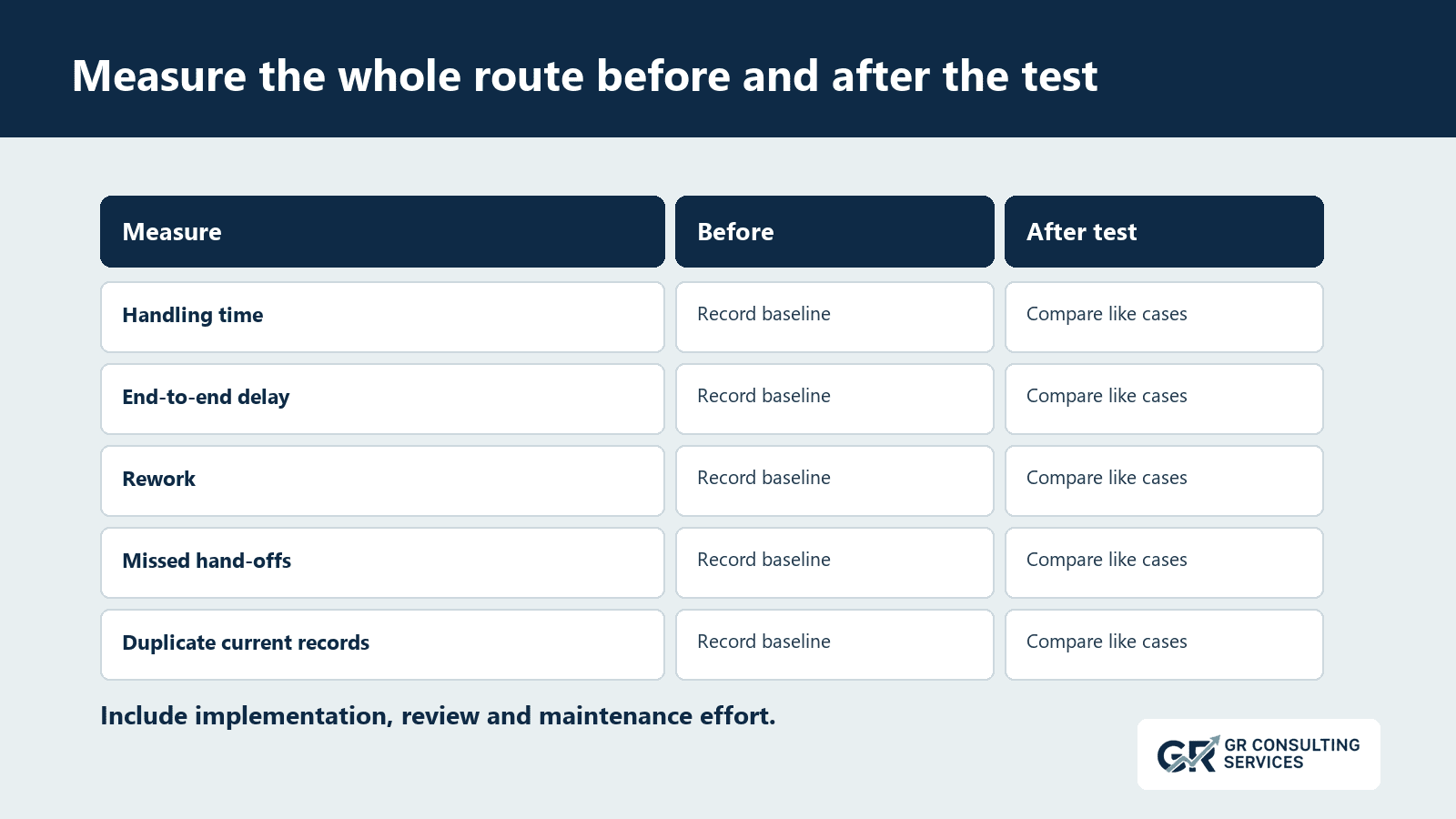
| Measure | Start and end point | Practical recording method |
|---|---|---|
| Handling time | Human work from draft receipt to all required updates complete | Short time log by case |
| End-to-end delay | Source received to next actions visible to owners | Source and assignment timestamps |
| Rework | Time spent correcting or re-entering information after review | Correction log |
| Missed hand-offs | Required destinations or owners not updated by the cut-off | Completion checklist |
| Duplicate current records | Places that appear to hold the same current decision | Record inventory |
| Exception rate | Cases that stop or require manual resolution | Exception queue |
Compare the median for a small group of similar cases. Record implementation time, licence cost, maintenance and review effort as well. A lower handling time may still produce a weak business case if exceptions consume the saving or staff must maintain a complex connection.
Do not convert staff minutes into a cash saving unless the organisation can explain how it uses the released capacity. Time released may improve response speed, reduce backlog or protect quality. It does not become profit by arithmetic alone.
Use the result to make one decision:
- keep the revised route;
- correct a named failure and retest;
- return to the previous process;
- expand to one adjacent hand-off after the owner accepts the maintenance work.
Stop the pilot if the team cannot explain access, source status or correction. Adding more records will spread the defect.
Connect one AI-assisted workflow to the way your business keeps decisions and assigns work.
If repeated copying or correction points to a wider systems problem, apply for a Business Clarity Diagnostic with GR Consulting Services.
This paid first step identifies the main constraint, clarifies priorities and recommends the most sensible route forward. It starts from £495.