

An automated workflow can produce more output while the source, exception route and review process remain weak.
A changed service description gives a simple example. One old instruction can feed several acknowledgements, proposal drafts and task notes. The team then pays to find each copy, correct it and explain the mismatch.
The initial build price tells you little about that operating burden. A sound decision needs the monthly cost of running, reviewing and maintaining the route.
This guide gives small businesses a provider-neutral method. It uses one fictional worked example with stated assumptions. The figures demonstrate the calculation; they do not predict a return for another business.
Define the Business Outcome and Baseline
Start with the result the business needs.
Automate enquiry handling names a method. Send an accurate acknowledgement within one working hour and assign the next action names an outcome that a team can measure.
Record the manual baseline before the pilot:
- cases handled per month;
- staff minutes per case;
- delay from receipt to response;
- corrections and missed hand-offs;
- staff cost for the work;
- complaints or lost opportunities linked to delay or error.
Use a fixed period and state any limits. Ten quiet days will not represent a seasonal rush. A clean test set will not show the incomplete forms and unusual requests that staff handle during normal work.
The UK Government AI Playbook recommends early work with the people involved in a process so the team can understand the problem and establish baseline measures. The Government's Digital and Data Benefits Framework also recommends a baseline and sensitivity tests for assumptions about uptake, time savings and cost reduction. Those methods suit small businesses even though the source guidance addresses public-sector work. AI Playbook and Digital and Data Benefits Framework
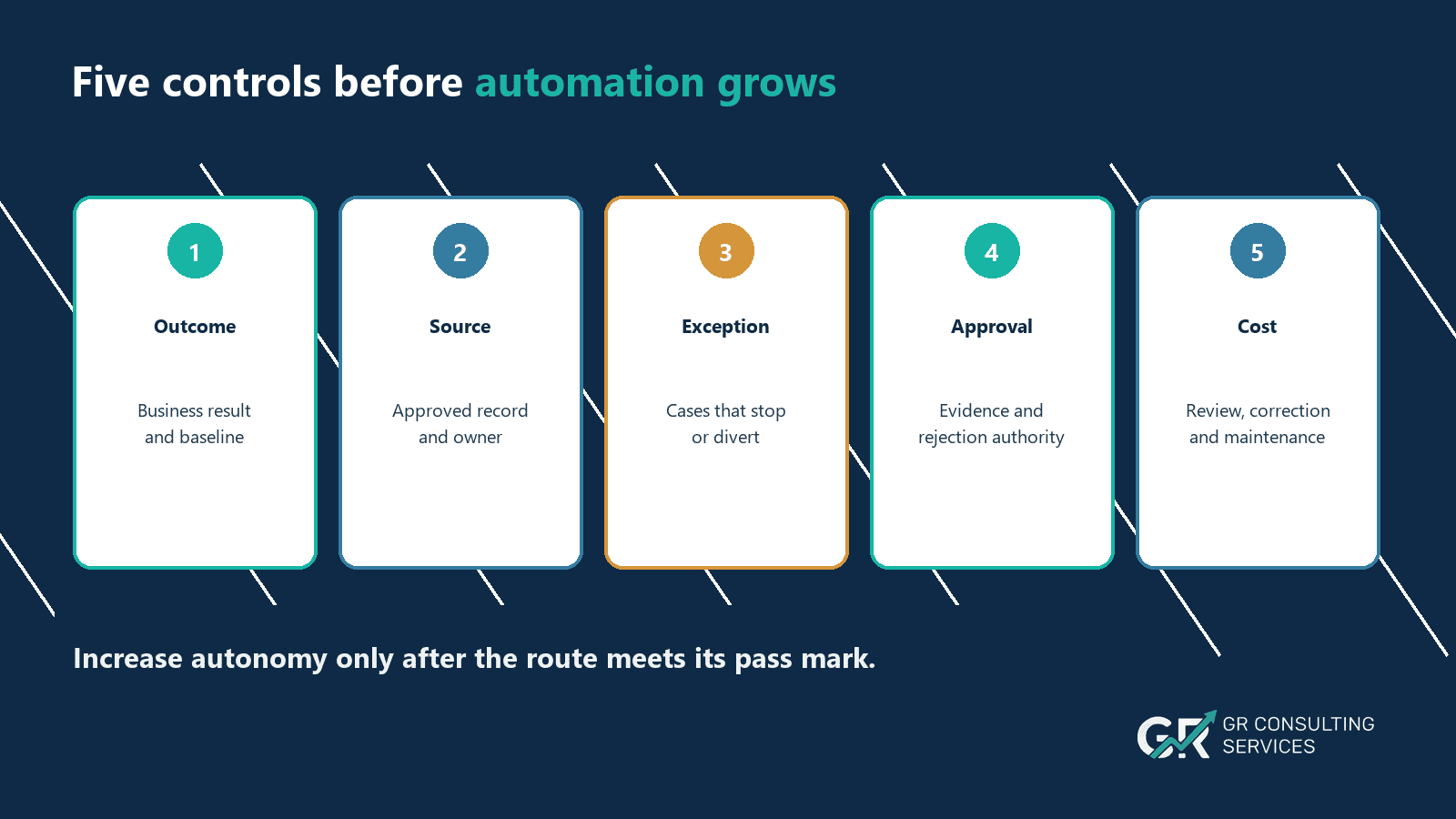
Set a pass mark before the pilot. For an enquiry route, the team might require:
| Measure | Example pass mark |
|---|---|
| Source accuracy | Every released message uses the current approved service description |
| Required details | No released message invents a price, deadline or commitment |
| Exception handling | Every missing, conflicting or sensitive case stops before release |
| Approval | A named reviewer can reject the draft and see the source used |
| Record update | The approved outcome reaches the current task record once |
These are example controls. Match the pass mark to the consequence and reversibility of your workflow.
| Condition | Route | Owner action |
|---|---|---|
| Required information present and consistent | Prepare a draft | Reviewer checks before release |
| Required information missing | Stop and request human handling | Person obtains or confirms the detail |
| Sources conflict | Stop before drafting | Source owner resolves the conflict |
| Complaint, unusual commitment or sensitive detail | Divert to the human route | Qualified person handles the case |
Do not force each exception back into automation. Some cases need relationship judgement, negotiation or professional expertise. The exception route protects the customer and gives the team evidence about the workflow's real shape.
Place human approval where a mistake would create a commitment, publish information, change a record or affect a person. Give the reviewer:
- the original request and source used;
- the pass criteria;
- authority to edit, reject or stop;
- a route for correcting the maintained source;
- enough time to examine the work.
The ICO says meaningful reviewers need knowledge, authority and capacity to challenge AI-supported decisions. It also recommends fallback options and logs of overrides. A click recorded as approval does not help when the reviewer lacks the source or cannot reject the output. ICO human review guidance
For decisions with legal or significant effects on people, data-protection and sector duties may set stricter requirements. Obtain qualified advice before implementation.
| Measure | Definition |
|---|---|
| Handling time | Staff minutes from receipt to approved outcome |
| Exception rate | Stopped or diverted cases divided by all cases |
| Correction rate | Cases that require factual, reasoning or commitment changes |
| Approval time | Reviewer minutes per case and queue delay before decision |
| Source failure | Cases that use, find or expose the wrong record |
| Duplicate correction | Copies a person must repair after one source change |
| Operating cost | Subscriptions, usage, integration, review, correction and maintenance |
Record the reason for each override. Grouping every intervention under `human review` hides the information needed to improve the route. Use categories such as missing field, source conflict, sensitive case, unsupported claim and integration failure.
Set a pause threshold. Examples include one released message with an invented commitment, any client-boundary breach, a source failure or an exception rate above the team's planned capacity. The owner then stops the affected route, uses the manual fallback and investigates the cause.
NIST's AI Risk Management Framework treats monitoring as lifecycle work. Its 2026 report says teams need post-deployment monitoring to check performance in real settings and identify unforeseen outputs or consequences. The report also says monitoring methods remain immature, so each business should state its method and limits rather than imply a standard score. NIST AI RMF Core and NIST post-deployment monitoring report
| Cost | Calculation | Monthly amount |
| Subscription | Fixed plan allocation | £70 |
| Usage | Model and processing estimate | £15 |
| Integration and monitoring | Connector, hosting and support allocation | £45 |
| Standard review | 88 x 1.5 minutes at £30 per hour | £66 |
| Exception review | 12 x 6 minutes at £30 per hour | £36 |
| Corrections | 4 x 10 minutes at £30 per hour | £20 |
| Maintenance | 2 hours at £35 per hour | £70 |
| Opportunity cost | 1 separate owner hour | £60 |
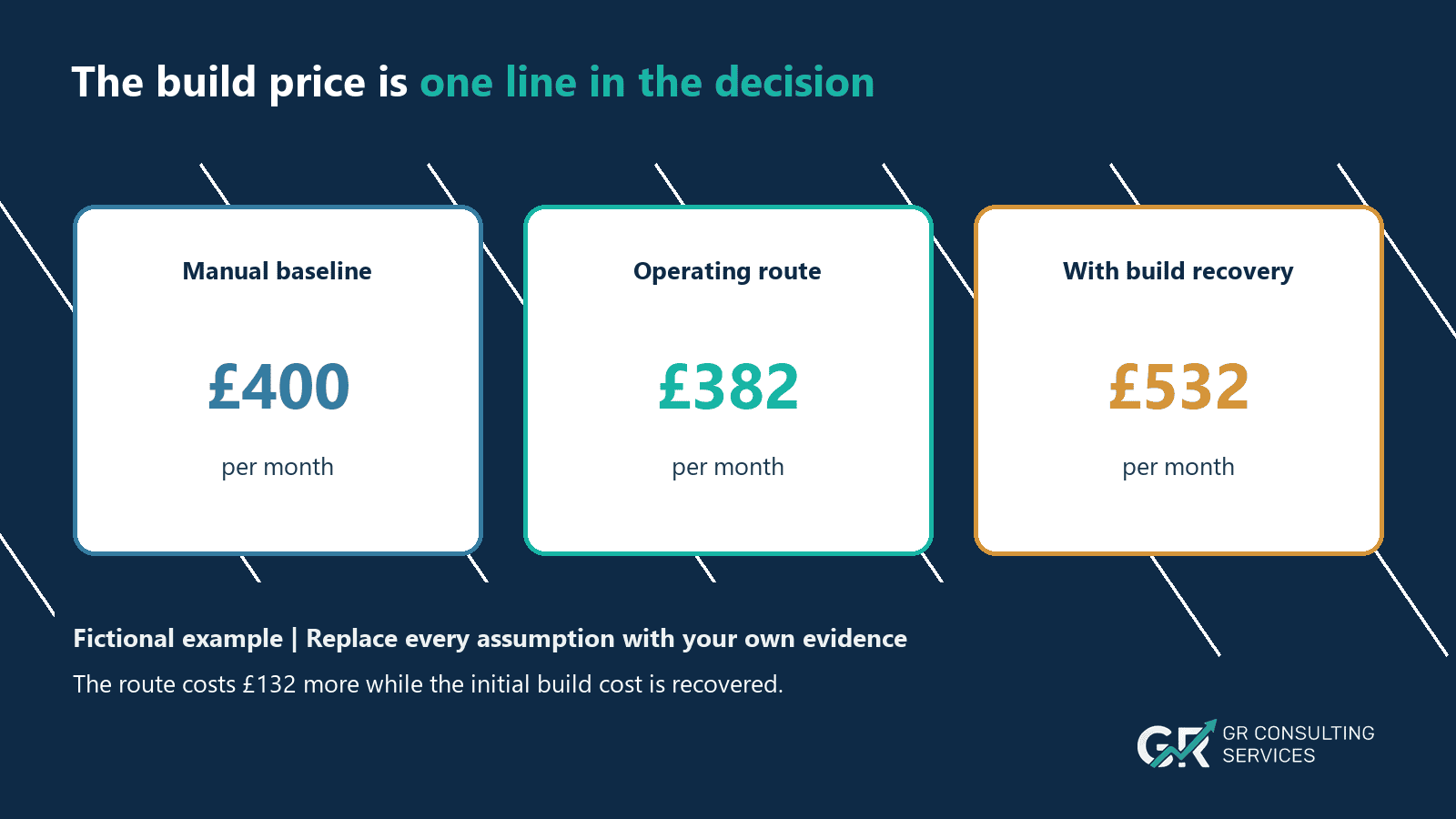
| Operating total | £382 | |
| Build recovery | £1,800 / 12 months | £150 |
| Monthly total with build recovery | £532 |
The operating route costs £18 less than the £400 manual baseline before build recovery. It costs £132 more per month during the 12-month build-recovery period.
That result does not make the pilot a failure. The consultancy may value a shorter response delay, fewer missed hand-offs or better records. It needs evidence for those benefits. A claimed time saving does not become cash unless the business removes paid capacity, avoids new cost or uses the released time for work that produces measurable value.
The approval decision should state the trade-off:
Keep the pilot bounded for one month. Do not expand it until response delay, missed hand-offs or conversion evidence justifies the extra £132 per month during build recovery. Stop the route if it releases an invented commitment, uses an unapproved source or exceeds the team's exception capacity.
Run sensitivity checks before approval. If exceptions rise from 12% to 25%, or each approval takes three minutes, the cost changes. If the team processes 300 similar cases without a proportional rise in maintenance, the economics may improve. Test the plausible range rather than selecting the assumption that supports the purchase.
Assess one automation idea before it becomes another system to maintain.
If you need to decide whether an automation idea is worth its cost and operating burden,
apply for a Business Clarity Diagnostic with GR Consulting Services.
This paid first step identifies the main constraint, clarifies priorities and recommends the most sensible route forward. It starts from £495.