
An AI project can become difficult to assess before it becomes technically complicated.
The first scope may include several tasks, several sources and several people checking different outputs. When something goes wrong, the team cannot easily tell whether the problem came from the source information, the instruction, the tool, the review process or the way the task was defined.
A smaller project gives the team a clearer question: can we make this one piece of work useful, controlled and maintainable?
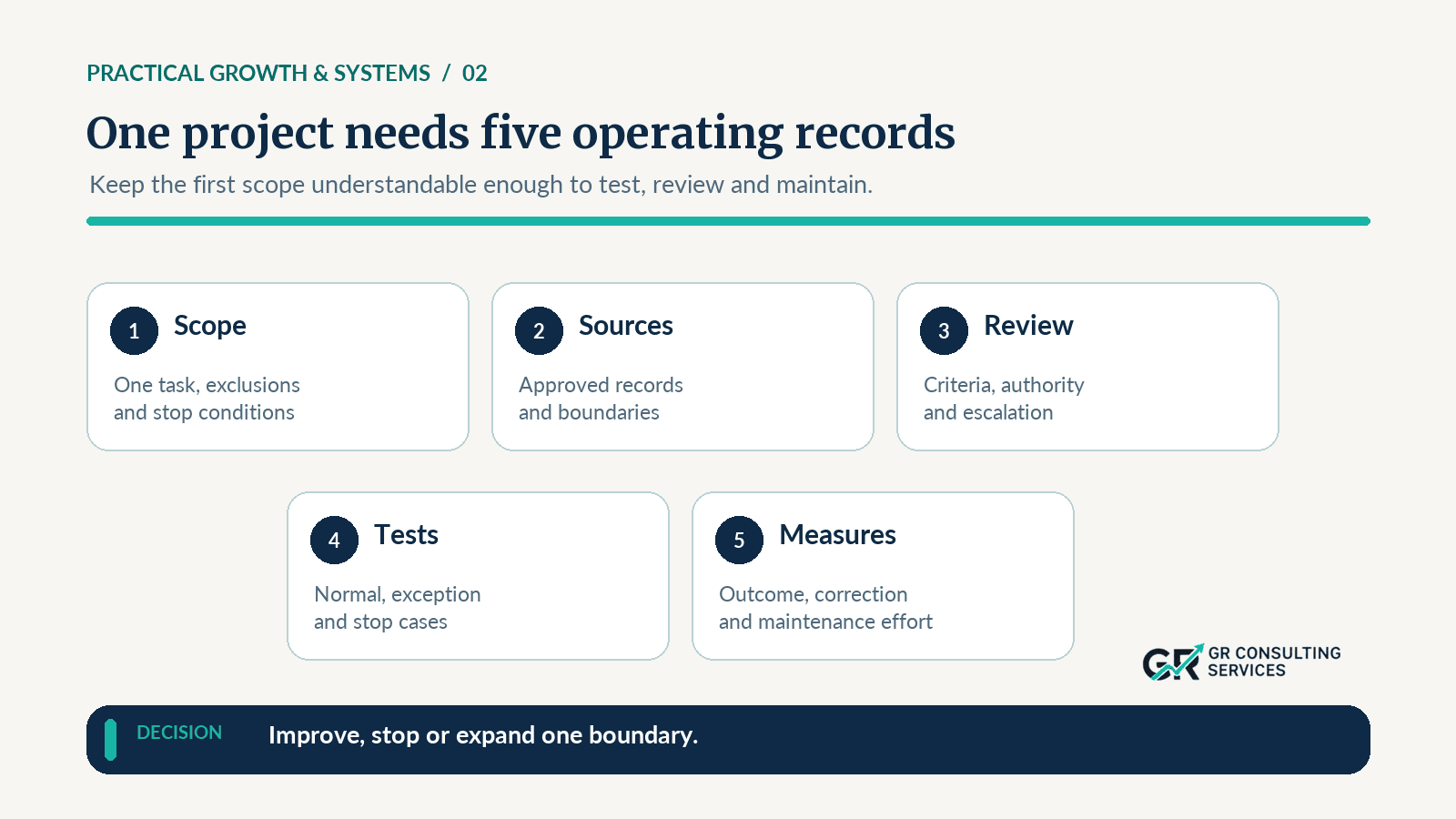
This guide turns that question into five operating records. It builds on our earlier practical AI starter framework by showing what a small team should write down and test before connecting more work around the project.
A minimum project record
The complete structure can fit on one page:
| Record | Minimum content |
|---|---|
| Scope | One task, intended output, people affected, exclusions and stop conditions |
| Sources | Approved records, owners, update triggers and information boundaries |
| Review | Acceptance criteria, reviewer, authority, escalation and rejection route |
| Tests | Normal case, exception case, stop case and manual fallback |
| Measures | Baseline, outcome, corrections, delay, review time and maintenance effort |
The point is not to create documentation for its own sake. It is to make the trial understandable enough that another person can see what is being tested, what evidence controls the result and who can stop it.
Decide whether to improve, stop or expand
Set a review point before the trial begins.
At that point, compare the observed result with the original problem and the maintenance effort. Then make one of three decisions:
- Improve: keep the same boundary and correct one known weakness.
- Stop: retire the route because the value, control or maintenance case is not strong enough.
- Expand: change one boundary only after the current project remains useful and controlled.
Expansion may mean adding one source, one type of output or one adjacent task. Changing several things together makes it difficult to know what produced the next result.
The smallest useful AI project is not the one with the fewest files. It is the one the team can explain, review, maintain and judge.
If you need help choosing a suitable first project, defining its operating boundary or deciding what to remove, apply for a Business Clarity Diagnostic.
Sources and limitations
- Artificial Intelligence Playbook for the UK Government, checked 1 October 2026. Government guidance adapted here as practical operating principles for small businesses.
- ICO human review guidance, checked 1 October 2026. Detailed requirements depend on the processing and its effects. The ICO states that this guidance is under review following legislative changes.
- NIST AI RMF Core, checked 1 October 2026. Voluntary US framework; AI RMF 1.0 is being updated.
This article provides general operational guidance. Businesses should separately check applicable law, contracts, data-protection duties, information-security requirements, provider terms and sector rules.
Choose one next action
Take a workflow your team already uses. Identify its current record, owner and next review trigger. If those are unclear, resolve them before adding another helper or integration.
If you need help deciding what to maintain, simplify or stop, apply for a Business Clarity Diagnostic. This paid first step starts from GBP 495 and helps clarify the main issue and the next sensible route.