
Shadow AI can start with an ordinary task: rewriting an email, summarising notes or comparing supplier information in a tool the business has not approved or recorded.
Small-business leaders need visibility before they can set useful rules. Start with five questions:
- which business task is involved;
- which tool and account the person uses;
- which information goes into it;
- whether the output stays a draft or triggers an action;
- who checks the result and owns the use.
Once you understand the use, set an approved route and apply task-level controls such as input, output and review boundaries.
AI Use Has Outpaced Rules
AI adoption has moved faster than formal operating rules in many organisations.
Microsoft and LinkedIn's 2024 Work Trend Index surveyed 31,000 people across 31 countries. It reported that 75% of global knowledge workers used AI at work and 78% of AI users brought their own AI tools to work. The figure reached 80% among AI users in small and medium-sized companies.
Those figures describe a global 2024 survey, not current UK prevalence. They still show why leaders should ask about current use rather than wait for an incident or procurement request.
Staff may use AI to reduce admin, speed up drafting or understand information. Without an approved route, each person makes separate choices about tools, accounts, data and review.
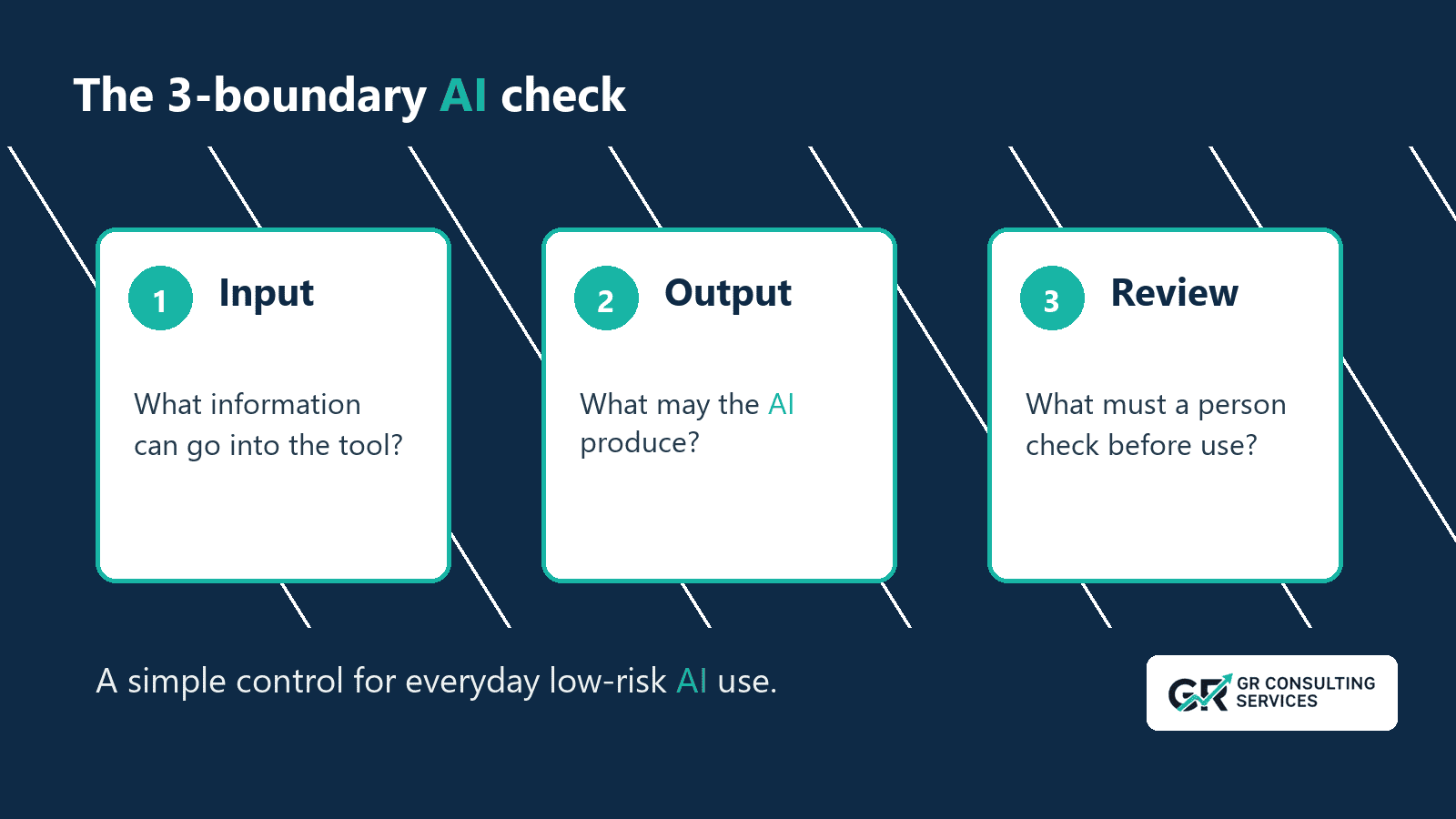
2. Output Boundary
The output boundary answers:
The output boundary answers:
| What is the AI allowed to produce?
Useful outputs include:
- a draft;
- a summary;
- a comparison;
- a list of questions;
- a first-pass checklist;
- options for a person to consider.
Riskier outputs include:
- a final decision;
- an instruction to another person;
- a commitment to a client;
- legal, financial or HR advice treated as authoritative;
- anything that updates a business record automatically;
- material sent without review.
For everyday SME use, the safer default is simple:
| AI may draft, summarise, compare and suggest. A person decides, approves, sends and records.
That distinction keeps the tool useful without pretending it has business authority.
3. Review Boundary
The review boundary answers:
| What must a person check before using the output?
For most business tasks, review should include:
- facts;
- names;
- dates;
- commitments;
- tone;
- source support;
- confidentiality;
- missing context;
- whether the output changes the meaning of the source material.
Client-facing wording needs close review. A confident AI draft can introduce a promise, deadline, interpretation or recommendation that the business has not agreed.
The instruction should make review visible:
| End with a checklist of what I should verify before using this output.
That small line changes the shape of the work. It makes the AI output easier to inspect rather than harder to challenge.
The review boundary answers:
| What must a person check before using the output?
For most business tasks, review should include:
- facts;
- names;
- dates;
- commitments;
- tone;
- source support;
- confidentiality;
- missing context;
- whether the output changes the meaning of the source material.
Client-facing wording needs close review. A confident AI draft can introduce a promise, deadline, interpretation or recommendation that the business has not agreed.
The instruction should make review visible:
| End with a checklist of what I should verify before using this output.
That small line changes the shape of the work. It makes the AI output easier to inspect rather than harder to challenge.
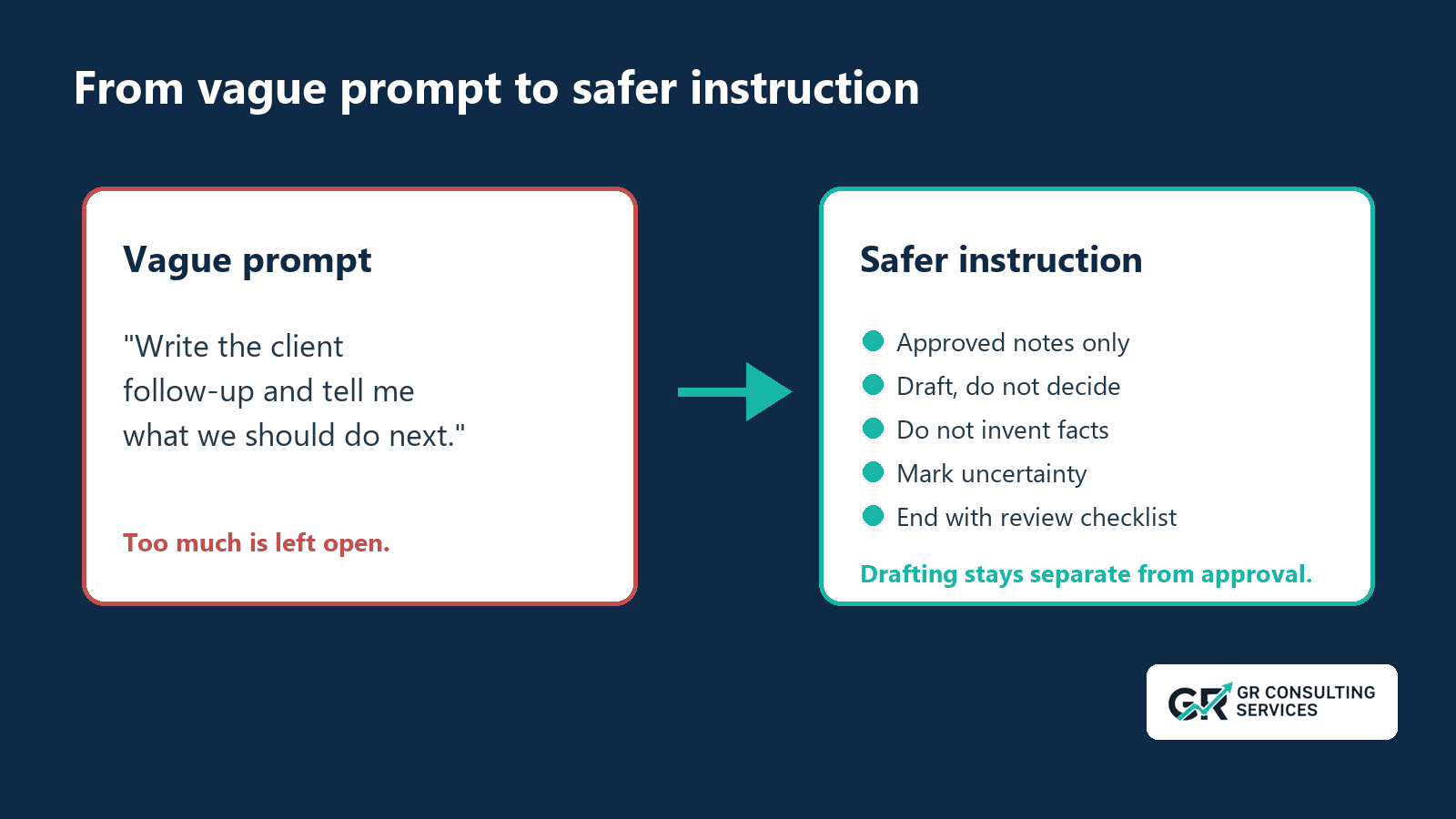
The Sensible Next Step
If AI use is already happening, give people a safer default.
Start with:
- one narrow task;
- one approved tool or route;
- one input boundary;
- one output boundary;
- one review rule.
These controls establish a usable starting point for AI governance.
GR Consulting Services helps founder-led SMEs turn informal AI experimentation into practical operating habits: clear use cases, safer instructions, better context, human review and sensible workflow design.
Find one useful AI opportunity and the controls it needs.
Shadow AI Starter Register and Safer AI Instruction Card. If you want help deciding where AI can save time without creating avoidable risk, book an opportunity call with GR Consulting Services. We will discuss one real business task, the information involved and a practical next step.