

An AI tool can produce a polished answer from the wrong service description, an old price or a note that nobody approved.
The model may have followed the request but used weak business context.
Small teams often solve the problem by pasting more material into the chat. That approach spreads copies, hides the source and makes review harder. A maintained workspace gives the task a smaller, controlled set of context.
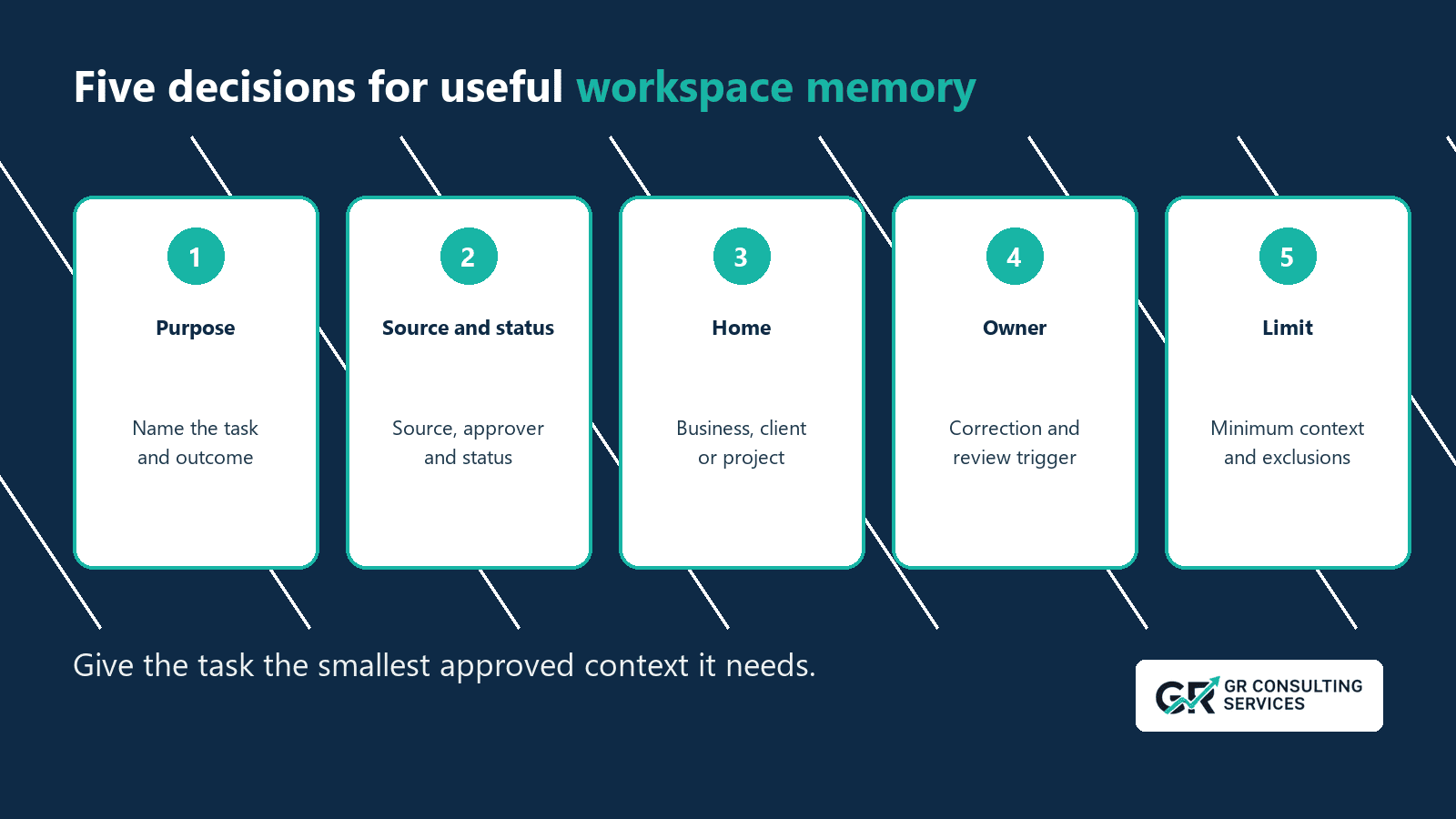
This guide uses workspace memory as an operating term. It means approved business context that people maintain for defined AI tasks. It does not refer to one provider's memory feature, and it does not remove the need for human review.
What We Learned From Our Own Workspace
As we expanded our internal AI workspace, one practical problem became harder to ignore. Improving one area did not update every related file, instruction or summary. Material that was once accurate could remain in place after the source changed.
The problem was not limited to storage. Each new task added another set of relationships to maintain: source material, working instructions, approved records, project notes and summaries used elsewhere. A tidy structure could still contain conflicting versions.
This is a GR Consulting Services observation from our own work. One internal case cannot show how often the same problem occurs across SMEs. Current guidance supports the underlying disciplines. The UK Government's data asset management policy calls for named ownership and a mechanism for managing data quality. NIST treats AI risk management as lifecycle work rather than a one-off implementation step. GOV.UK data asset management policy and NIST AI RMF 1.0
Our response was to reduce the first scope. Prove one project or repeated task before you connect more of the business.
| Record type | Purpose | Example | Control |
|---|---|---|---|
| Source | Preserves evidence or origin | Signed proposal, approved web page, meeting record | Keep provenance and access clear |
| Workspace memory | Supplies maintained context across tasks | Current service description, tone rule, approved client fact | Add status, owner and review trigger |
| Task record | Tracks work and commitments | Owner, due date, status, next action | Update through the task process |
| Chat | Holds working conversation | Draft questions, temporary analysis, alternative wording | Do not treat it as the business record |
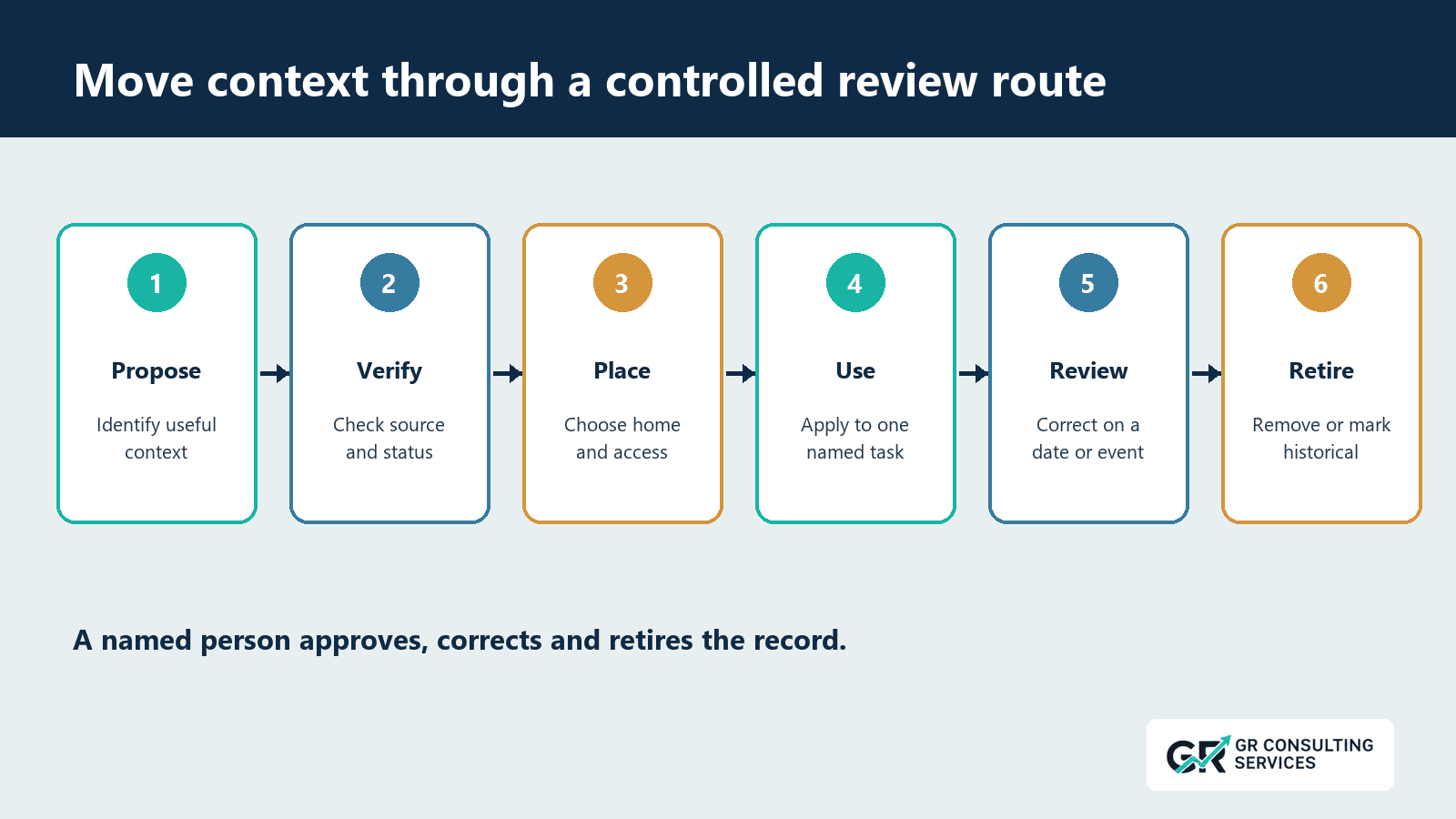
The distinctions protect the audit trail. A raw transcript can support a decision record. A person reviews the decision, approves the record and updates the right workspace. The chat remains a working area.
| Measure | Test |
|---|---|
| Context accuracy | Did the output use current approved facts? |
| Traceability | Could the reviewer locate the source for each material claim? |
| Separation | Did the task avoid other clients and unrelated business records? |
| Review effort | How many minutes did correction take? |
| Retirement | Could the owner remove or mark stale context in one place? |
Stop the pilot if the team cannot explain access, source status or correction. Adding more records will spread the defect.
Common Failure Points
Treating Chat History as the Record
Chat history can preserve useful working context, but it does not replace an approved business record. Copy the confirmed outcome into the maintained home and keep the source reference.
Adding Every Document
Large document sets increase stale and irrelevant context. Include records because the named task needs them.
Mixing Draft and Approved Material
A polished draft can look authoritative. Give each record a visible status and stop draft material from entering tasks that require approved facts.
Mixing Clients
Place each client's context inside its approved workspace. Test the boundary with similar names and services before use
Assigning No Owner
A review date without an owner creates an unattended reminder. Name the person who has authority to correct or retire the record.
Automating Personal Judgement
Context can support a person without replacing their authority. Keep complaints, sensitive negotiations and relationship decisions under human control.
Keeping Superseded Copies
Mark the current record and remove or archive duplicates under the retention rule. Search results should not give an old record equal status.
A Practical Starting Point
Pick one repeated task that already relies on copied context.
Create a small approved set. Give each record a purpose, source, status, home, owner, update trigger and retirement rule. Remove material the task does not need. Test known examples and one boundary case.
Expand only after the team proves that it can maintain the review route. The first goal is a context set that people can trace, correct, separate and retire without searching duplicate folders or old chats.
Give one AI task accurate business information that your team can maintain.
Run the five-part check on one repeated, low-risk task. If stale facts, unclear ownership or mixed client information keeps weakening the result, book an opportunity call with GR Consulting Services. We will examine the task and define a manageable source and review process.