

A small business can improve one piece of work before it designs a wider AI setup.
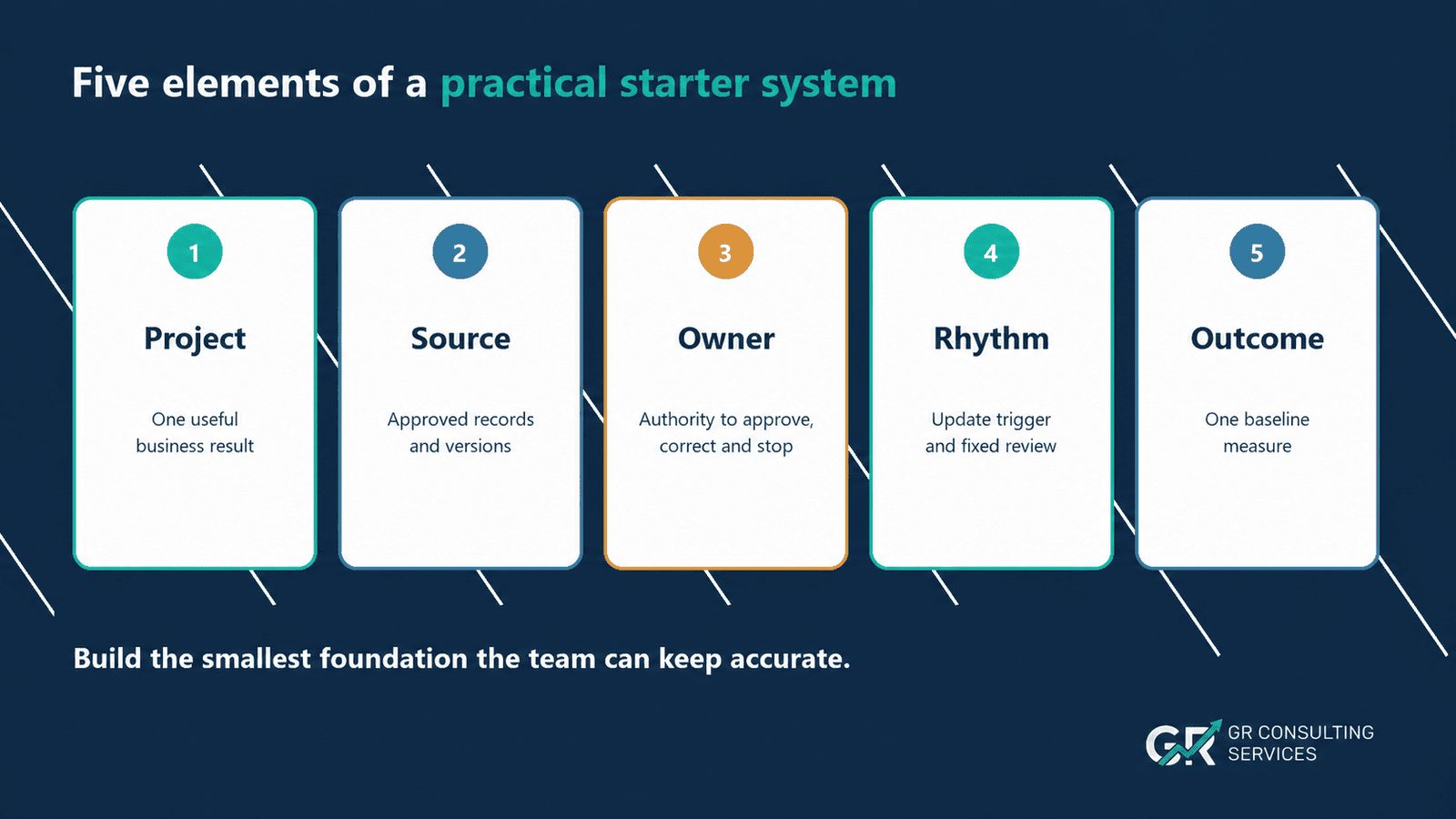
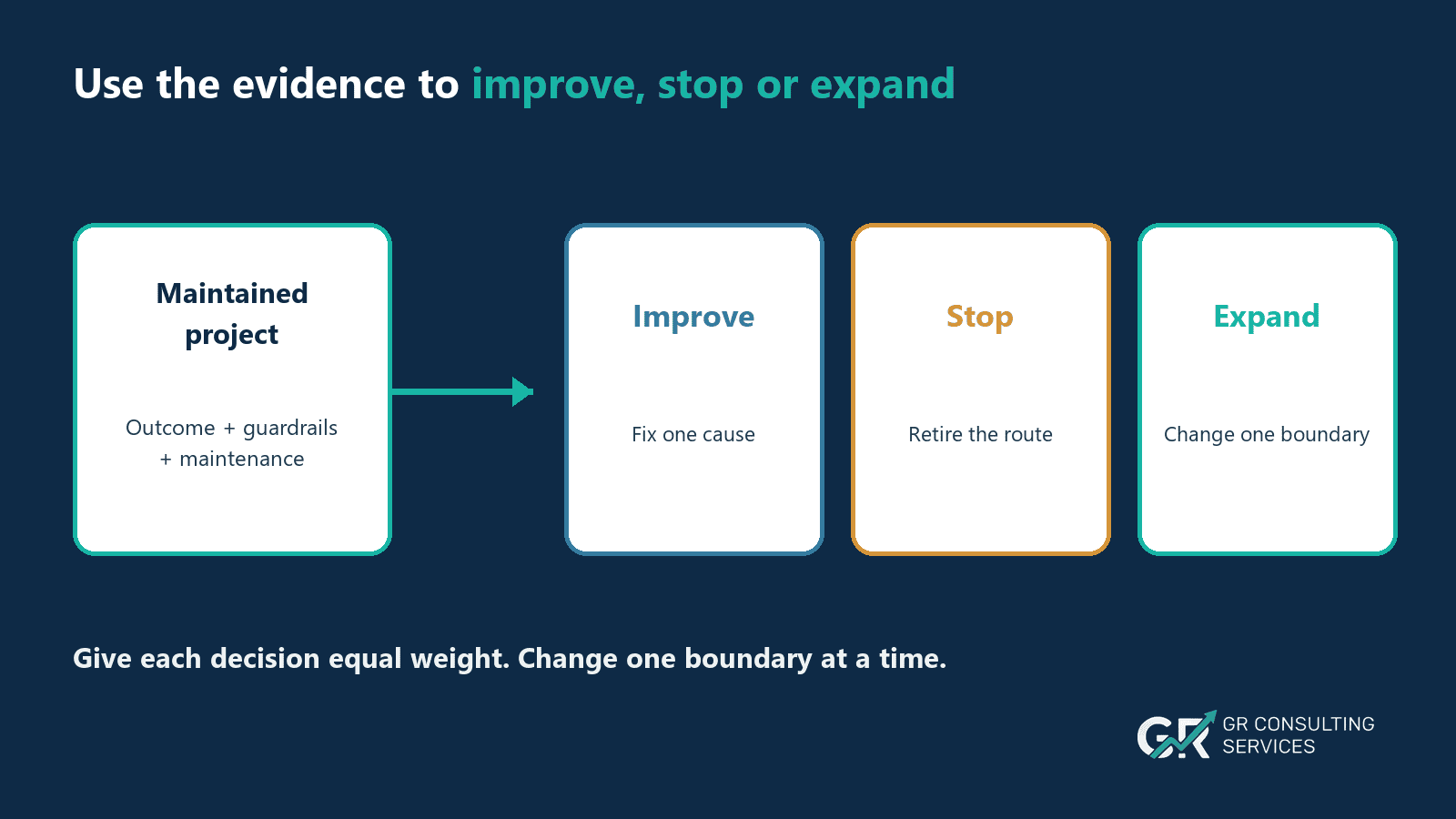
It needs one useful project with a maintained source, an accountable owner, a review rhythm and a measurable outcome. Those five elements give the team enough structure to test value, correct stale information and stop work that crosses an agreed boundary.
Consider a fictional consultancy that wants to send an accurate client follow-up within one working day of each meeting. The team could spend weeks comparing tools and building assistants. A smaller test would follow one route from the reviewed meeting record to an approved message and the next action in the existing task system.
The team still needs to make business decisions. Which record can the draft use? Who checks commitments? Which update changes the instructions? Which result will justify keeping the project?
This guide turns those decisions into a six-step starter system. It stays provider-neutral because the task, information and operating capacity should shape the tool choice.
| Element | Required decision | Meeting follow-up example |
|---|---|---|
| One useful project | Define a bounded business result | Send an approved follow-up within one working day |
| One trusted source set | Name the approved records and versions | Reviewed meeting record and current service information |
| One accountable owner | Give a person authority to approve, correct and stop | Client services manager |
| One review and update rhythm | Set event-based updates and a fixed review | Update after each meeting; review the route each month |
| One measurable outcome | Compare a primary result with the baseline | Median time to approved follow-up |
The five elements form an operating minimum. Each business should extend the controls to match the consequence. A regulated or high-consequence use may need formal assurance and specialist review. A low-consequence internal draft may need less.
| Measure | Purpose |
|---|---|
| Median time to approved follow-up | Primary business outcome |
| Follow-ups requiring a factual or commitment correction | Quality guardrail |
| Owner review minutes per follow-up | Capacity guardrail |
| Cases stopped for missing, conflicting or sensitive information | Boundary evidence |
| Monthly source and instruction maintenance time | Operating cost |
Do not turn saved minutes into cash without evidence. Time creates capacity. The business receives a financial benefit after it avoids cost, handles more valuable work or improves another measured outcome.
The Digital and Data Benefits Framework recommends baseline costs, ownership of the benefits case and sensitivity checks for uncertain assumptions. Its scope concerns government business cases, but the measurement discipline transfers to a small project. Test a slower review time, more exceptions and lower usage before approving expansion. Digital and Data Benefits Framework
Keep campaign measurement separate from project measurement. Post impressions and engagement show content distribution and response. Relevant decision-maker conversations, enquiries and attributable business outcomes need their own records. None can substitute for evidence from the live business process.
| Campaign lesson | Decision inside the project |
|---|---|
| Week 1 - One useful task | Define a bounded result |
| Week 2 - Task and workflow | Map the route and current record |
| Week 3 - Reusable instructions | Store the approved job and limits |
| Week 4 - Safer use | Set information, decision and review boundaries |
| Week 5 - Input efficiency | Require the details that change the result |
| Week 6 - Model choice | Match capability, cost and access to the task |
| Week 7 - Transcript capture | Obtain suitable source material with permission |
| Week 8 - Workspace memory | Maintain approved context and separate client truth |
| Week 9 - Connected workflow | Send approved work to the correct business record |
| Week 10 - Controlled automation | Define exceptions, approval and operating cost |
| Week 11 - Agent readiness | Count the instructions, sources and hand-offs the team must maintain |
| Week 12 - Practical starter system (this article) | Hold the project together with an owner, rhythm and outcome |
This sequence describes the campaign's operating method. The final analytics review will assess how the content performed after the full reporting window; it will separate reach and engagement from relevant response, enquiries and business outcomes.
Assess one useful project before adding more AI tools or assistants.
If your team needs to choose or repair its first practical AI project, apply for a Business Clarity Diagnostic with GR Consulting Services.
This paid first step identifies the main constraint, clarifies priorities and recommends the most sensible route forward. It starts from £495.